
I. INTRODUCTION
To make children and other vulnerable witnesses comfortable while testifying, courts are increasingly permitting such witnesses to be accompanied by specially trained dogs while on the stand. This use of dogs long precedes references in cases.
For a discussion of that early history of this phenomenon, see Marianne Dellinger, Using Dogs for Emotional Support of Testifying Victims of Crime, 15 Animal Law Review 171 (2008). For a discussion of the history of facility dogs up to 2013, see Casey Holder, Comment: All Dogs Go to Court: The Impact of Court Facility Dogs as Comfort for Child Witnesses on a Defendant’s Right to a Fair Trial, 50 Houston Law Review 1155 (Symposium, 2013) (stating that “currently sixteen states allow dogs into the courtroom.”). Another law review article published only a few months later found 21 states had implemented courthouse dog programs. Sarah Bowers, The Use of ‘Therapy Dogs’ in Indiana Courtrooms: Why a Dog Might Not Be a Defendant’s Best Friend, 46 Indiana Law Review 1289 (2013). For a recent assessment of the number of canine support programs for victim witnesses, with details about the numbers of dogs in some programs, see David LaBahn and Amy Farina, Providing Comfort, Companionship, and Relief: The Use of Courtroom Dogs. 81(12) The Police Chief 24 (December 2014). A student note published the same year focused on New York law and argued that therapy dogs should not be permitted to assist children testifying during criminal trials. Abigayle L. Grimm, An Examination of Why Permitting Therapy Dogs to Assist Child-Victims When Testifying During Criminal Trials Should Not Be Permitted, 16 Journal of Gender, Race and Justice 263 (2013). Another article focusing on a specific state, Pennsylvania, reviewed cases from all jurisdictions before voicing a preference for the position of the Supreme Court of Washington State. Matthew Kaiser, Sit … Stay … Now Beg for Me: A Look at the Courthouse Dogs Program and the Legal Standard Pennsylvania Should Use to Determine Whether a Dog Can Accompany a Child on the Witness Stand, 60 Villanova Law Review 343 (2015).
Some of these articles refer to prosecutions where facility dogs were used but where no judicial decision or order with substantial discussion described the use of a dog in a judicial proceeding. The discussion here, however, confines its analysis to such judicial pronouncements. This article is being posted online so that discussions of new cases can be easily added to show how the acceptance of dogs with a function of helping a witness testify is evolving.
A. Terminology
At present, the preferred judicial and legislative term for a dog accompanying a witness during testimony is “facility dog,” though cases, statutes, and literature have also called them testimony dogs, courthouse dogs, companion dogs, therapy dogs, service dogs, comfort dogs, therapy assistance dogs, support dogs, victim support dogs, and therapeutic comfort dogs. Most of these terms imply canine functions in providing comfort or reducing anxiety (emotional support dogs) and should be avoided because the function of the dogs in a courtroom setting is far more specific. Most dogs previously described in cases have been trained in a manner similar to how therapy dogs are trained, but not all dogs were actually trained or certified therapy dogs so this term would also be confusing. A service dog is generally a dog that assists a particular individual with a disability, but facility dogs may be used with vulnerable witnesses in a particular state while living with a master who is not disabled. Therefore, that term is also best avoided. Companion dogs are generally pets, though some degree of need may be implied in specific contexts. Calling a dog a courthouse dog has a clever journalistic ring, but might suggest the dog lives in the courthouse, or is on call like a stenographer or translator. In the end, facility dog or testimony dog may be the best choices, and facility dog will be used as the default setting here. It should perhaps be noted that the term facility dog is sometimes used to refer to a dog, often trained as a therapy dog, that remains in a single facility, such as a nursing home, assisted living facility, or a school, though this use of the term has not been common in case law.
B. Tabular Summary of U.S. Decisions
The decisions involving facility dogs (or dogs designated as having similar functions) used for the testimony of children or vulnerable witnesses are summarized in the following table, which lists key aspects of the parties, dogs, as well as two issues that are becoming paramount in resolving objections to the use of such dogs: what must be shown by the prosecution in order for a court to grant a motion to allow such a dog to accompany a witness (including where the burden lies), and what efforts must be made to limit possible prejudice from the jury’s awareness of the dog’s accompaniment of a witness.
|
Case (Year) |
Victim or Witness/ Ages |
Defendant |
Dog/ Qualification |
Required Showing |
Effort to Minimize Prejudice |
|
California v. Spence (2012) |
11-year-old step daughter of defendant |
Sexual assault including penetration and sodomy |
Dog not described aside from fact it sat at victim’s feet |
No claim of interference with defendant’s right to confront and cross-examine victim-witnesses; lack of evidence dog’s presence affected jury |
Jury cautioned; trial court took care to ensure dog mainly unnoticeable; trial judge stated that improper activity of therapy dog would result in its removal from courtroom |
|
Washington v. Dye (2013) |
Adult male with developmental disabilities and mental retardation |
Fraudsters convicted of aggravated first-degree theft, residential burglary |
Ellie, Golden Retriever trained by and living with prosecutor |
Not defendant’s burden to prove prejudice by dog but prosecution’s burden to prove special dispensation necessary for vulnerable witness, but need not prove substantial need or compelling necessity; also defendant failed to establish his fair trial rights were violated or that jury instructions largely mitigated prejudicial effect |
Witness allowed to give treats to dog during testimony; caution to jury; if Ellie had played with victim or growled at defendant, trial court could have removed her from courtroom |
|
New York v. Tohom (2013) |
15-year-old daughter of defendant |
Father accused of predatory sexual assault, endangering welfare of child |
Rose, Golden Retriever, trained from age of 8 weeks to sense stress and anxiety and present herself to be petted |
Defendant failed to show accommodation of comfort-therapy dog was impermissible under state statute on support persons and accommodations of child witnesses, impaired right to fair trial, or compromised right of confrontation and cross-examination; trial court had discretion where animal could ameliorate psychological and emotional stress of a testifying child witness; necessity requirement for prosecution not preserved for appellate review |
Instructions to jury to minimize prejudice; dog’s presence in courtroom described as unobtrusive |
|
Washington v. Moore (2014) |
Wife of defendant |
Husband convicted of assault with domestic violence |
Dog named Keris, referred to as a service or comfort dog |
No evidence presence of dog made witness appear traumatized or victimized |
No objection at trial so issue of prejudice not preserved for appeal |
|
California v. Chenault (2014) |
Girls/11 and 13 (daughters of niece of defendant) |
Male relative convicted of multiple forcible lewd acts on his daughter and girls within family |
Described as support and companion dog, “trained in providing support” |
No burden on prosecution to show individualized necessity; presence of dog should assist or enable witness to testify |
Dog brought in and out without jury present, kept as inconspicuous as possible (though apparently within sight of jury); caution to jury |
|
Ohio v. Jacobs |
Girl between 11 and 15 at time of abuse, but 17 at time of trial |
Stepbrother of child's mother; child considered him an uncle |
Described as "companion dog;" presumably the dog was certified as court distinguishes the decision of the court of appeals in Devon D. (Conn.) by noting dog in that case was not a certified service dog |
Court distinguished situation before it from Devon D. (Conn.) by noting dog here had bonded with child beginning a week before testimony and dog was trained and had been used in abuse cases before and presumably was certified (unlike dog in Devon D.); court emphasized victim suffered from "psychological ailments" |
Dog was described as sitting at victim's feet during her testimony, but no indication concerning the dog's visibility to the jury or the rest of the courtroom |
|
Ohio v. George (2014) |
Two children, 6 and 8 years old |
Boyfriend of mother convicted of rape of victims under 10 years old |
Dog named Avery described as facility dog, companion dog, working dog |
Trial court declines to rule on objection to presence of dog as a Daubert issue; during pre-trial hearing, Avery did not behave at one point and defense counsel renewed his objection to dog’s presence in courtroom; no objection at trial meant appellate court did not need to address defense assignments or error with regard to use of dog |
Dog not permitted to wear any identification of prosecutor’s office and handler not to wear prosecutor’s shirt or cover it with jacket or sweater but jury saw dog enter with witness; caution to jury |
|
Tennessee v. Reyes (2016) |
Boy, 10 years old |
Family friend, male adult |
Service dog provided by Upper Cumberland Child Advocacy Center named Murch; trained for 2 years in obedience and had passed “public access tests”; handler trained in 2-week program |
Court permitted use of dog provided dog could be made available to any witness who testified (without restricting that to a victim or child) |
Trial judge stated for record that jury could not see the dog at side of jury box; limiting instruction indicated dog did not belong to a witness and was available to both prosecution and defense |
|
Smith v. Texas (2016) |
Witness concerning attack was 10-year old son of victim | Boyfriend of victim |
Service dog available at Children’s Advocacy Center |
Court found presence of dog “generally for the child’s comfort and anxiety and mental well-being.” Defense did not make specific objections at trial other than general prejudice argument |
Dog introduced to witness box and removed out of view of jury though not clear that jury was completely unaware of dog’s presence |
|
Michigan v. Johnson (2016) |
Girl, 6 years old | Friend of family who babysat child |
Black Labrador retriever (named Mr. Weeber) described as “therapy dog from the prosecutor’s office” though court referred to dog generally as “support animal” |
Trial court had “inherent authority to control its courtroom and the proceedings before it to allow a witness to testify accompanied by a support animal…. We therefore reject defendant’s argument that the trial court was required to make findings of good cause or necessity before it allowed the use of the support animal.” |
Appellate court declined to overturn based on lack of limiting instruction but indicated one would have been advisable and expressly approved limiting instruction used in Chenault. |
|
Connecticut v. Devon D. (2016) |
Three children of defendant, respectively 6, 8, and 10 years old when the alleged abuse began | Multiple charges of sexual assault and risk of injury to a child |
Dog named Summer owned by therapist; dog referred to by Supreme Court as a service dog that had not yet been certified but had reached the “testing age of two” |
Supreme Court said the pivotal question is whether the use of the dog will aid the witness in testifying truthfully and reliably |
Trial court provided caution to jury; dog apparently kept from jury’s view |
Summarizing the descriptions of the dogs, in no cases were the dogs required by a court to be trained by any specific organization or under any training regimen. In three cases (Spence, Devon D., and Dye), there was no indication of training at all, though in Devon D. the appellate court had said that a dog should be “suitably trained” but the Connecticut Supreme Court referred to the dog used as a service dog that had not been certified but had reached the testing age of two years. In Tohom, the dog was trained to sense stress, and in Chenault the dog was trained in providing support, but no specifics of training were given. In Moore the dog was described as a service or comfort dog, in Jacobs as a companion dog, in George as a facility, companion, and working dog, in Smith as a service dog, and in Johnson as a therapy dog.
Only in Reyes was the length of the dog’s training specified as taking two years, with an indication that the dog had passed public access tests. Public access tests of the sort provided by the American Kennel Club can be passed with much less training than two years, so presumably much of the training in Reyes came from a service dog program. Since there was no elaboration on what training meant in the context of this case, it could also mean that the indicated time might have included the time that the dog was to some extent under the control of the training organization, which could include the period during which it was being fostered. Opposing counsel should always investigate such claims.
As will be discussed below, the tendency of courts towards openness in the types of dogs that can function in a courtroom with a child or vulnerable witness is in stark contrast to the increasingly specific, and one might say even monopolistic, requirements that legislatures have begun imposing statutorily.
C. Tabular Summary of Vulnerable Witness Statutes Referencing Facility Dogs or Other Animals for Witness Support
Six states have so far passed legislation pertaining to the use of an animal, in all but one case specifically a dog, with a child or vulnerable witness. There is greater uniformity, and specificity, as to the requirements placed on dogs in the statutes than has been true of the case law.
| State Statute (date of enactment) | Terms Defined and/or Used (victim, dog, handler) | Organizational Requirement for Training | Precautions (notice, visibility, limiting instruction) |
| Arizona Revised Statutes 8-422D (child safety) and 13-4442D (victims’ rights) | Facility dog; assistance dog; victim. | Assistance dog organization that is a member of an organization or entity whose main purpose concerns training, placement, and use of assistance dogs, staff and volunteer education. |
Moving party must file notice on dog’s certification, individual or organization certifying, and insurance; court must allow for victim under 18, may allow for 18 or older; jury instruction required. |
| Arkansas Code Annotated 16-43-1002 (2015) | Child witness; certified facility dog; certified handler. | For dog: Assistance Dogs International (ADI) or similar nonprofit organization. For handler: ADI, AKC, Therapy Dogs Inc., or equivalent organization. |
Availability in judicial district in which criminal case is adjudicated; must have established relationship with child witness; party requesting use of dog must file motion; brought by handler to witness stand in absence of jury; voir dire of jury can include questions re effect of dog. |
| Florida Statutes 92.55 (2012) | Service or therapy animal; victim or witness under 16, or with intellectual disability, or sexual offense victim or witness. | Animal evaluated and registered according to national standards. | Court to consider relevant factors in setting conditions for taking testimony of child victim or witness, including considering the rights of the parties to the litigation. |
| Hawaii (H.B. 1668; SB 2112, signed by Governor 6/30/2016) | Facility dog; vulnerable witness. | Graduate of ADI member organization; since dog has to be “specially trained to provide emotional support to witnesses testifying in judicial proceedings without causing a distraction,” only Courthouse Dogs, Inc. may at present qualify to train facility dogs in Hawaii. | Court to determine compelling necessity for use of facility dog; moving party to provide credentials, insurance, and certify that “relationship has been established between the witness and the facility dog;” court may impose restrictions and instruct jury regarding dog’s presence. |
| 725 Illinois Compiled Statutes 5/106B-10 (2015) | Facility dog; intellectual disability can be moderate, severe, or profound; developmental disability includes but is not limited to cerebral palsy, epilepsy, and autism. | Graduate of ADI member organization. | Court to consider age of child or person, rights of parties, and “any other relevant factor that would facilitate the testimony by the child or the person.” |
| Oklahoma Statutes 12-2611.2F; 12-2611.12 (2014) | Child witness; incapacitated witness; certified therapeutic dog. |
Trained and certified by the AKC, Therapy Dogs Incorporated or equivalent organization. | Court to conduct hearing on dog’s credentials, insurance, and relationship with child witness prior to use. |
Of the six state statutes that so far specifically refer to the use of facility dogs (or dogs, however designated, permitted to accompany witnesses during testimony), two (Illinois and Hawaii) require that the dog be trained by a member organization of Assistance Dogs International (ADI). Arizona does not specifically refer to ADI, but does require that a facility dog be trained by “an assistance dog organization or entity whose main purpose concerns training, placement, and use of assistance dogs, staff and volunteer education.” It would be difficult for any therapy dog organization to fit within such a requirement and it may be intended to be specific to ADI without naming it. Arkansas specifies that the dog must be trained by “Assistance Dogs International (ADI) or similar nonprofit organization.” Since that state allows the handler to be trained by ADI, the American Kennel Club, Therapy Dogs Inc., “or equivalent organization,” arguably a national therapy dog organization could be considered, as to the dog, an appropriate training organization, but defense counsel should investigate this issue thoroughly. Florida states only that the animal must have been “evaluated and registered according to national standards.” That would include therapy dogs. Oklahoma states that the dog must be trained and certified by the AKC, Therapy Dogs Inc. “or equivalent organization.” This would also include therapy dogs.
Thus, three states definitely see ADI members as the only source for a facility dog, and Hawaii may only allow Courthouse Dogs to provide facility dogs. Arkansas may allow a facility dog to come from someone besides ADI, but a prosecutor would clearly be safest using a dog trained under an ADI-member program. Only two states, Florida and Oklahoma, seem receptive to therapy dogs. On the other hand, of the 11 cases decided so far, as noted in the previous section of this article, no court has specifically determined that a dog used with a witness at trial had to be a member of any organization. As more states adopt limiting legislation, previous case law will effectively be narrowed as to what dogs can be used with child and vulnerable witnesses.
D. Institutional Advocates
The Courthouse Dogs Foundation, at present the leading advocate on the use of facility dogs in the United States, states on its website that facility dogs specialized “in assisting individuals with physical, psychological, or emotional trauma due to criminal conduct … should be graduates from assistance dog organizations that are accredited members of Assistance Dogs International to ensure that they do not create a public danger and are stable, well-behaved, and unobtrusive to the public. Facility dogs in the legal system are handled by criminal justice professionals, such as a deputy prosecutor, a law enforcement officer, a victim advocate, or a forensic interviewer.” Assistance Dogs International has a webpage devoted to training standards for facility dogs (http://www.assistancedogsinternational.org/standards/assistance-dogs/standards-for-dogs/training-standards-for-facility-dogs/).
A program developed by the American Humane Society, the Therapy Animals Supporting Kids (TASK)TM Program, argues for the use of therapy animals in legal proceedings where a “judge is open-minded and willing to consider the purpose of AAT [animal-assisted therapy] in the courtroom.” The manual is posted on the website of the American Humane Society (http://www.americanhumane.org/assets/pdfs/children/therapy-animals-supporting-kids.pdf), but states that it was developed in cooperation with Delta Society (Pet Partners), an organization that promulgates training standards and administers tests for therapy animals.
E. Legal Commentators
A note in the Indiana Law Review (Bowers, above) recommends that “organizations accredited by Assistance Dogs International” be used to train facility dogs. A commenter in a Houston Law Review Symposium (Holder, above) argues that an “appropriate canine should be one specifically trained for the legal world by an organization that specializes in training court facility dogs.” It is the author’s opinion that such recommendations are overly narrow and that no specific organization should be designated with authority to train or test dogs for work at trials. The prosecution should have the burden of establishing the dog was adequately trained or has evidenced the ability to function appropriately in a courtroom before. The standards provided by Assistance Dogs International for facility dogs are well drafted, but substantially similar to obedience and behavioral requirements for therapy dogs licensed by national therapy dog organizations. There is no need to create such a monopoly for a single or limited number of service or therapy dog organizations or trainers, or to turn the qualification of a handler for such a dog into a guild controlled by a small group of organizations. As will be discussed in the decisions that have dealt with facility dogs, courts have generally asked for a showing that the dog used would behave in the courtroom while performing its function. There is no need to disturb this dog-by-dog approach.
Note on the order of cases discussed herein: This article maintains a running revision format with newer cases added after the introduction so that readers periodically reading the updates to the case summaries in the article can avoid going through the legacy material. Similarly, the coverage of legislation in later sections of the article begins with the most recent statute and moves backward. This is not to say, however, that comments on older cases and statutes may not change to reflect new perspectives reached by the author from time to time.
II. TRIAL COURT HAD DISCRETIONARY AUTHORITY TO ALLOW USE OF DOG TO PROVIDE COMFORT AND SUPPORT
Connecticut v. Devon D., SC 19378, 2016 WL 3194779 (June 14, 2016).
Devon D. was convicted of four counts sexual assault and three counts of risk of injury to a child upon allegations made by three of Devon D.’s biological children, C1, C2, and C3. He appealed his conviction on the grounds that the trial court had abused its discretion by having the three cases to be tried jointly and by permitting C1 to testify with a dog at her feet. The appellate court had accepted these arguments and reversed and remanded for a new trial, but the Supreme Court of Connecticut reversed the appellate court.
C1 had told her mother and later a clinical child interview specialist about being in her grandmother’s bedroom when her father “had poured some lotion on her body, as well as poured the white stuff from his wee-wee on her body, and had contact with her genitals with his fingers.” Her father had also inserted his finger in her vagina while bathing her and using a rag, causing her to bleed. He had penetrated her “private part” and her “butt” with his penis and had ejaculated several times. He forced her to perform fellatio, causing her to vomit. Similar incidents were described by C2 and C3.
The Connecticut Supreme Court concluded that “the trial court properly exercised its discretion in permitting the cases to be tried together because the evidence in all three cases was cross admissible,” and reversed on that issue. As to the appellate court’s determination that the trial court had abused its discretion in permitting a dog to sit near C1 during her testimony to provide comfort and support,” the Supreme Court also reversed, reinstating the verdict and judgment of the trial court.
A. Service Dog in Trial Court
On July 5, 2011, the prosecution filed a motion to permit a dog “to sit in close proximity to [C1] during [C1’s] testimony, provided that such dog and the dog’s handler shall not obscure [C1] from the view of the defendant or the jury….” C1 had indicated to the victim witness advocate that she was concerned about people looking at her in the courtroom. The trial court conducted a full evidentiary hearing on the procedure under Connecticut v. Jarzbek, 204 Conn. 683, 529 A.2d 1245 (1987). At the hearing, a licensed clinical social worker testified that the dog, Summer, had been trained to be a service dog and occasionally provided support to children in his practice who experienced anxiety. The Supreme Court noted that at “the time of the trial, Summer had not yet been certified as a service dog because she had only just reached the testing age of two.”
The Supreme Court referred to the appellate court’s discussion of the appropriate name to be given a dog assisting a witness during testimony. The appellate court had quoted introductory language from this article and had agreed that the term “facility dog” was useful, but the Supreme Court preferred just to refer to Summer as a dog, without any qualifying adjective.
C1 had met Summer two hours before the Jarzbek hearing began and had initially refused to touch the dog but “became more and more comfortable as she began to pet her,” according to the social worker, who also noted that the girl had touched the dog’s teeth, sat with her on the floor, and was progressively “more connected and less fearful.” He said that the dog’s presence increased C1’s ability to engage, to answer questions and to talk. The Supreme Court stated:
When defense counsel asked Meyers whether he had any way of knowing “whether . . . [C1 would] be able to be more truthful, more reliable, have better memory of events that are a couple of years old with the presence of a dog or without a dog,” Meyers responded that, in his experience, “when kids are anxious, they’re less likely to be able to talk about those things, memories and life experiences. [C1] appeared less anxious during our time, so I’m not sure if that’s a clear answer to your question, but it would be my opinion, as a dog handler child therapist, that she appeared more comfortable.” In response to questioning from the court, Meyers explained that Summer would be able to lay still for five or six hours.
Defense counsel objected to the use of the dog, arguing that General Statutes §54-86g provides special procedures for the testimony of a child in a criminal prosecution of an offense involving assault, sexual assault, or abuse of a child 12 years old or younger, and that those special procedures include the presence of a trusted adult in close proximity and use of anatomically correct dolls but say nothing about the use of a dog. Defense counsel suggested that the child testify on closed circuit television or hold a teddy bear while testifying. The trial court, approving the use of the dog, noted that it would prevent “the need for the more drastic and onerous” procedure of video recording C1’s testimony. Later on in the opinion, the Supreme Court observed that the use of a video recording of testimony would be a greater interference with the defendant’s right to confront the witness than would the use of the dog. The trial court ruled that permitting the dog to be present was within its discretion, but directed that the dog be “put in place [on the witness stand] … in such a way that the dog will not be viewed by the jury in any way, shape or form.” The Supreme Court stated:
The record indicates that Summer was, in fact, put into place on the stand, out of view, before the jurors entered the courtroom for C1’s testimony. There is nothing in the record to suggest that the jurors ever saw Summer, and the defendant does not claim that the jurors ever viewed the dog.
Prosecution and defense counsel stipulated that jury instructions would provide that the “witness is anxious about testifying in front of a group of people. The dog is not present due to any concern the witness has with the defendant’s presence. The … dog met the witness [the day before] in preparation for court trial.” The jury heard these instructions when the trial began, just before C1 testified, and as part of the final charge. The jury was admonished to disregard the presence of the dog, to draw no inference for or against any witness using a dog, and to “[t]hink of the dog like an interpreter, an aid to get the witness’ testimony across to you more clearly.” Thus, even if the jurors did not see the dog, they must have been quite aware that one was present during some of the testimony.
B. Connecticut Supreme Court Reinstates Trial Court Judgment
The appellate court reversed, finding that the trial court had made no finding or showing that a special procedure involving a dog was needed. The Supreme Court criticized the appellate court for failing to discuss what would constitute a showing of need, but determined that the question was not whether there was a compelling need but rather whether the trial court abused its discretion. A trial court, according to the Supreme Court, “has inherent discretionary authority, separate and apart from [Conn. Statutes §54-86g], to order special procedures or accommodations to assist a witness in testifying.” Connecticut courts have previously permitted child witnesses to hold dolls and stuffed animals (Connecticut v. Aponte, 249 Conn. 735, 738 A.2d 117 (1999); Connecticut v. McPhee, 58 Conn. App. 501, 755 A.2d 893 (2000)). The Supreme Court stated:
We conclude that the pivotal question is not whether the special procedure is necessary but whether it will aid the witness in testifying truthfully and reliably. We further conclude that the record in the present case demonstrates that the trial court expressly found that Summer would help C1 to testify more reliably and completely and that Summer’s presence would not violate the defendant’s right to a fair trial. Finally, the record indicates that the trial court took extensive measures to ensure that the jurors never saw Summer. On the basis of the record, we conclude that the trial court properly exercised its discretion.
The court discussed five previous cases involving dogs: Chenault, Spence, Tohom, Jacobs, and Dye, all discussed separately in this article, and found the trial court’s approach consistent with those cases. The appellate court was revered and the case was remanded to the trial court to render judgment according to the verdict.
III. FAILURE TO OBJECT AT TRIAL DOOMS ANOTHER APPEAL
Michigan v. Johnson, --- N.W.2d ----2016 WL 1576933 (Mich. Ct. App., 2016)
Jordan Conrad Johnson was convicted of first- and second-degree sexual conduct and on appeal challenged the trial court’s ruling allowing a witness to be accompanied while testifying by a support animal. The sexual conduct alleged by the prosecution occurred when the defendant was asked, by his brother and sister-in-law, to babysit his six-year old niece.
While babysitting, defendant would take the victim into the bathroom or another room and sexually abuse her. One time, when the victim’s 10–year–old brother tried to investigate what was happening when defendant and the victim went into a different room, he was told to “go away.”
The babysitting occurred from 2011 to 2014 until in June or July of 2014 the victim revealed the sexual abuse to her parents.
The victim’s parents were planning on going out, but when the victim heard that defendant would be babysitting, she “became hysterical” and “broke down,” crying and screaming. The victim told her parents that she did not want defendant to babysit because defendant put “his penis in her butt.” Over the next couple weeks, the victim provided her parents with more details about the sexual encounters with defendant. The victim’s mother subsequently took the victim to the family doctor, who did not find any injuries to the victim’s butt or vagina, but did make the necessary report to Child Protective Services (CPS).
A sexual assault nurse examiner performed an examination of the victim at a hospital. After an initial reluctance to speak about the incidents, the child told the examiner that the defendant would put his fingers in her butt and his penis in her mouth, saying specifically that her uncle put “his penis in her mouth and he didn’t even wash it first.” The examiner saw a very thin, pale, vertical line in the victim’s anus, consistent with penile penetration.
The defendant testified that he had only disciplined the child and that the brother of the child would watch and laugh. The jury found the defendant guilty, and he appealed.
A. Mr. Weeber
A black Labrador retriever named Mr. Weeber was permitted, without objection, to accompany the six-year-old victim and the victim’s ten-year-old brother in the witness stand as each testified. The appellate court determined that, having failed to object at trial, the “defendant waived any issues related to the use of the support animal by affirmatively approving the trial court’s action.”
In describing the dog to the jury, the trial court referred to it as a “therapy dog from the prosecutor’s office.” On appeal the defendant took issue with the use of the term, and the appellate court acknowledged that “the term ‘therapy dog’ is not the most appropriate, particularly because the term could imply that the witness was undergoing therapy as a result of the sexual assault.” The court cited the language of the appellate court in Devon D.’s to the effect that “facility dog” is “the preferred term” and quoted that court’s quotation of this article on why other terms come with certain problems (citations were omitted), though the court used “support animal” in any case. As to the defendant’s objection to the use of “therapy dog” during the trial, the appellate court stated:
[T]he trial court also indicated that the dog was from the prosecutor’s office, thus signaling to the jury that the dog was not the witness’ own therapy dog, but rather one provided by the prosecution to assist the witness with providing testimony. Therefore, no error occurred and any objection to the trial court’s use of the term therapy dog would have been meritless.
B. Motion under “Support Person” Statute
The prosecution had moved to use the dog under Michigan Compiled Laws 600.2163a(4), which does not provide for a witness to be accompanied by a support animal but rather by a “support person.” The prosecution’s motion referred to Mr. Weeber as a “canine advocate.” Because defense counsel had no objection to the use of the dog at trial, on appeal the defendant argued that he had been denied effective assistance of counsel.
The appellate court acknowledged that a dog is not a “person,” and therefore a “support animal” is not a “support person,” but determined that the trial court “had the inherent authority to utilize this courtroom procedure,” noting that trial judges can control “the mode and order by which witnesses are interrogated.” This authority was sufficient to uphold decisions of trial judges to (1) shackle a defendant during a trial, (2) impose time limitations on examination of witnesses, (3) bind and gag an “unruly, disruptive, rude and obstreperous” defendant, (4) remove an uncooperative defendant from the courtroom, and even (5) allow jurors to ask questions of witnesses. Appellate courts had also approved trial courts in (6) permitting a witness screen to prevent a witness from seeing the defendant (though the appellate court later on in its decision did discuss Coy v. Iowa, 487 U.S. 1012 (1988) where the U.S. Supreme Court disapproved of such a procedure), (7) use of an anatomically correct dolls to help a witness demonstrate a sexual act, and (8) interactive videoconferencing of witnesses (close to a procedure approved by the U.S. Supreme Court in Maryland v. Craig, 497 U.S. 836 (1990), which involved the use of closed circuit television for the testimony of a six-year-old child witness).
Much like the use of a screen to make a witness more comfortable when testifying—but much less offensive to the Sixth Amendment Confrontation Clause—the use of a support animal allows the trial court to ease the situation for a young traumatized or fearful witness, while at the same time allowing the jury and the defendant to view the witness while testifying. We therefore hold that it is within the trial court’s inherent authority to control its courtroom and the proceedings before it to allow a witness to testify accompanied by a support animal.
Since the trial court had the authority to grant the use of a support animal, any objection at the trial level “would have been meritless” and, therefore, “counsel’s performance did not fall below an objective standard of reasonableness for failing to object on this basis.” The court noted that it could have even been part of the defense counsel’s trial strategy to let the witnesses testify in the presence of the dog:
At trial, the defense’s theory was that the victim was “coached” to say that defendant committed these sexual acts. In fact, during closing argument, defense counsel argued that the victim was able to “spit back, so to speak, her script,” and that she kept “saying the same thing that we think was fed to her by these other people, her parents or whatever.” Thus, it very well could have been trial counsel’s strategy to allow the support animal to accompany the victim while testifying so that she would appear calm while testifying, which would make it appear that she was coached on what to say at trial. Consequently, defendant has not overcome the strong presumption that counsel’s performance was sound trial strategy.
Arguably, however, a defense argument that a victim is speaking from a script might be better served by a halting witness who because of discomfort has to start over and over again and always parrot the same catch phrases in doing so.
C. No Violation of Confrontation Clause
The appellate court also rejected arguments that the use of the support animal was inherently prejudicial and therefore a denial of due process. The use of the support animal did not brand the defendant with the mark of guilt but was “merely present to assist the witness.” The court cited other state appellate courts that had approved the use of dogs with witnesses, including Tohom, Chenault, Dye, Jacobs, Spence, and Devon D. The use of the dog also did not violate the right of the accused to confront a witness:
Here, the use of a support dog did not implicate the Confrontation Clause because it did not deny defendant a face-to-face confrontation with his accuser as the victim and the victim’s brother testified on the witness stand without obstruction. In addition, the presence of the dog did not affect the witnesses’ competency to testify, did not affect the oath or affirmation given to the witnesses, the witnesses were still subject to cross-examination, and the trier of fact was still afforded the unfettered opportunity to observe the witnesses’ demeanor. Accordingly, defendant’s right to confrontation was not implicated by use of the procedure and no specific-finding was required to ensure compliance with the Confrontation Clause. We therefore reject defendant’s argument that the trial court was required to make findings of good cause or necessity before it allowed the use of the support animal.
D. Failure to Provide Limiting Instruction Not Reason to Overturn
On appeal, the defendant argued that a limiting instruction should have been requested by his counsel. The appellate court said that the jury had been instructed to decide the case based on the evidence, not based on sympathy or bias, and that this was sufficient because jurors are presumed to follow instructions. In a footnote, however, the appellate court expressly approved the limiting instruction used in Chenault. Also citing that case, the court did recommend that one procedure be implemented:
When a witness will be testifying accompanied by a support animal, it may be wise for the witness and support animal to get situated on the witness stand outside the presence of the jury…. Once situated and the jury returns to the courtroom, the trial court should inform the jury that the witness will be accompanied by a support animal while testifying.
Assuring an appellant that the appeals court can serve as the alter ego of the trial court may be the easiest way to put a case to rest, but it cannot overcome the fact that only the trial court had before it the real parties, the real witnesses, and the real dog. Such ventriloquism of a lower court means that the matter is resolved in the abstract by appellate judges. Nevertheless, the appellate court is correct that the defense has mostly itself to blame.
IV. TEXAS COURT IS CAREFUL TO KEEP DOG FROM JURY’S VIEW
Smith v. Texas, No. 14-15-00037-CR, 2016 WL 1576933 (Ct. App. 2016)
Jonas Smith was convicted of aggravated assault against Lakeisha Toree Holman, a woman he had known since high school. Ms. Holman, the complainant lived with her ten-year-old son, K.J., and four-year-old daughter, T.W. According to the testimony at trial, Smith had stabbed Holman, but after bleeding for some time and after K.H. came home from school, the two took Holman to the hospital, where she described the assault to hospital staff. Smith was arrested.
A. Defense Counsel Loves Dogs
Before trial, the prosecution orally informed the trial court that a service dog might be in the courtroom during the testimony of K.H. The following exchange occurred:
[THE STATE]: Your Honor, this does not relate to the motion to suppress. I just wanted to make the Court and [appellant's counsel] aware that we do have a juvenile witness testifying in this case, and he has the opportunity to connect with a service dog that is available at the Children's Advocacy Center. That's been available to him, and he has expressed interest. And so at the time of his testimony tomorrow the service dog may be employed. I'm not sure that that's happened in this court before. I know it's happened in other district courts in this building. But I wanted to raise the Court's awareness of that now.
THE COURT: Are you going to have any objection?
[APPELLANT'S COUNSEL]: I love dogs.
THE COURT: There we go.
Later, during trial but outside of the presence of the jury counsel and the judge had an additional exchange in which the prosecution explained how the dog would be kept unobtrusive:
THE COURT: So the issue, on the record, is the Defense has asked about the service dog. We have a ten-year-old that will be testifying later today. A service dog has been provided to aid him in his testimony. And so maybe the State can better answer what the use of service dogs, you know, promotes or why.
[THE STATE]: Well, I think it's generally for the child's comfort and anxiety and mental well-being while they're in the scary setting of the courtroom.
[THE STATE]: The child is ten, and he's testifying about a violent event that he witnessed involving his mother. He is seeing a therapist connected with this event.
[THE STATE]: He also has not been in the presence of the defendant since the night of the arrest and the assault itself, so this will be his — just coming in the courtroom just now was his first opportunity to view the defendant since it happened.
[THE STATE]: And the service dog is going to be at the child's feet outside of the view of the jury. It's very unobtrusive and not a distraction, and we don't see how that could be prejudicial.
[APPELLANT'S COUNSEL]: Will it be inside the box?
[THE STATE]: The dog's going to be sitting inside the box.
THE COURT: And what we'll do is we'll excuse the jury, seat the child and the dog. The therapist will be behind, the therapist relating to the dog, the handler of the dog, so that if the dog acts up or anything, that she's there to handle it, which is how I understand it's usually done.
[APPELLANT'S COUNSEL]: So she'll just be sitting in a chair?
THE COURT: In a chair behind, yes. And that will all happen — they'll all be seated, and then the jury will come in so they won't see. Then when the child is excused, they might see the dog wander out, but then it's after the testimony.
[APPELLANT'S COUNSEL]: Okay. Well, I would just lodge an objection. I think it's overly prejudicial.
THE COURT: I'll overrule the objection and note it for the record.
Clearly, defense counsel had come to realize that the dog might not be a good thing for his client. The opinion explains how the dog was actually brought into and later removed from the courtroom:
The record shows that the trial court did not allow the jury to be in the courtroom until K.H. and the service dog were seated on the witness stand. The trial court excused the jury and announced, "[W]e're going to take a short afternoon break and we'll be back here in ten minutes." Outside the jury's presence, the trial court seated K.H. and the dog. At the conclusion of K.H.'s testimony, the trial court announced, "Okay. We're going to have one more. This will be our last quick break in the afternoon, so just another ten minutes." After the jury exited the courtroom, the trial court excused K.H. and the dog from the witness stand, stating: "Okay, [K.H.], you did good. You can go." Thus, the jury was not present either when K.H. and the dog entered or later when they left the courtroom. Nor is there anything in the record to suggest that the jury saw or knew that a service dog had been in the courtroom and in the witness stand during K.H.'s testimony.
B. Belated Objections on Appeal
On appeal, the defense acknowledged that the objection at trial did not specifically reference article 38.074 of the Texas Code of Criminal Procedure, which concerns testimony of a child witness and provides for the use of a “[s]upport person … whose presence would contribute to the welfare and well-being of a child.” Tex. Code Crim. Proc. § 38.074.3(b) provides that on “motion of any party…, the court shall allow the child to have a toy, blanket, or similar comforting item in the child’s possession while testifying or allow a support person to be present in close proximity to the child during the child’s testimony if the court finds by a preponderance of the evidence that: (1) the child cannot reliably testify without the possession of the item or presence of the support person, as applicable; and (2) granting the motion is not likely to prejudice the trier of fact in evaluating the child’s testimony.”
The defense argued on appeal that a “support person” does not include an animal, that a “canine seated nearby is not the equivalent of a ‘toy, blanket, or similar comforting item in the child’s possession,” and that taking “measures to reduce the dogs visibility … does not mean the jury was unaware of the animal’s presence.” Further, “the state did not in any way establish that the dog was required for [K.H.] to ably testify,” and “there was “no indication that [K.H.] needed to avail himself of the dog, or that he had even interacted with the dog prior to taking the stand.” The defense claimed therefore that the trial court had abused its discretion and that “it is impossible to determine whether the dog’s presence influenced the ultimate verdict, and as a result, the conviction must be reversed and the cause remanded to the trial court for a new trial.”
The appellate court said, however, that because “appellant did not make any of these arguments in the trial court, they present nothing for our review.”
Before allowing ten-year-old K.H. to testify, the trial court gave the State and appellant an opportunity to present arguments. The State explained that a service dog's presence is "generally for the child's comfort and anxiety and mental well-being." The State further explained that (1) K.H. is ten years old and "in the scary setting of the courtroom;" (2) K.H. has to testify "about a violent event that he witnessed involving his mother;" (3) K.H. has not been in appellant's presence since the night of his mother's assault; (4) "the service dog is going to be at [K.H.]'s feet outside of the view of the jury;" and (5) the "dog's going to be sitting inside the [witness] box."
Further, “[a]ppellant did not present any evidence or argument at the hearing that the jury likely would be prejudiced by the presence of the service dog in the witness box.” The court was satisfied that “the trial court did not err by finding that the service dog’s presence was not likely to prejudice the jury in evaluating K.H.’s testimony.” Even if there was error, it was harmless, and the appellant court said any error alleged “does not implicate constitutional rights.” There was no discussion of the Confrontation Clause.
The court appears to have done a good job of keeping the dog as invisible as possible to the jury. This is the sort of precaution that should be required. It is perhaps worth noting that this case is one of the best reasoned in the entire area, yet reached its results without considering, at least in the appellate decision, any of the judicial history of facility dog cases.
V. TENNESSEE TRIAL COURT APPROVES OF DOG TRAINED TO BE “INVISIBLE” WITH LIMITING INSTRUCTION
Tennessee v. Reyes, No. M2015-00504-CCA-R3-CD, 2016 WL 3090904 (Tenn. Ct. App., 2016)
Jose Reyes, a family friend, was convicted of raping a boy who had sometimes remained overnight with him. The child was ten years old at the time of the trial and testified that the defendant “[s]tuck his privates in my butt.” By “privates” he meant penis.
A. Murch, a Service Dog, Provided by Child Advocacy Center
During the trial, the Upper Cumberland Child Advocacy Center provided a facility dog named Murch to accompany the victim during testimony. At a hearing on a defense motion to preclude use of the dog as “overly prejudicial,” Murch’s handler testified that the dog “had been trained from birth until he was nearly two years old for obedience, as a service animal, and had gone through public access tests." The handler had gone through a two-week program to learn how to be the dog’s handler. She testified that during a trial Murch was to lie “very quiet and calm,” be “invisible,” and provide “comfort.” The handler was also trained as a “forensic interviewer.” She testified concerning how Murch worked with the victim:
[The victim] was very apprehensive and appeared very anxious, scared and frightened about the process. After bringing Murch in and allowing [the victim] to spend a little time with him, he seemed to immediately calm down. He was drawn to the animal, pet [sic] the dog, and appeared to be a little bit more relaxed and able to focus and talk.
She stated that the victim was “much more relaxed and comfortable in the court environment with the animal present.” During testimony, she would have the victim be seated first, then would take Murch to him and place the dog in a “down command position.”
The prosecution advised the trial court that the dog would remain at the child’s feet during direct and cross-examination and would not be taken out of the witness box until the jury was excused from the courtroom. The trial judge stated for the record that the jury “could not see [the dog] much from what I can see, if he’s going to be at the side of this jury box. I can’t see him from where I am, the dog, that is.” The court permitted use of the dog and granted a defense motion to allow the dog to be made available to any witness who testified, though no other witness took advantage of this possibility. It might have been an advisable defense strategy to use the dog with one or more defense witnesses.
B. Limiting Instruction
At the conclusion of the trial, the judge gave a special jury instruction regarding Murch:
During this trial, a witness was accompanied by [a] courthouse facility dog. The dog is trained, it is not a pet and it does not belong to the witness. The dog is equally available to both the prosecution and the defense. You must not draw any inference regarding the dog’s presence. Each witness’[s] testimony should be evaluated upon the instructions that I give you.
The appellate court reviewed prior relevant cases including Dye, Chenault, and Tohom, and stated that “we cannot conclude that the trial court abused its discretion in permitting the use of the facility dog, Murch, during the trial.” The attempt to assign error to the procedure was determined to be “without merit.” Other defense arguments on appeal having been similarly rejected, the appellate court affirmed the judgment of the trial court.
The dog appears to have been highly trained to be as unobtrusive as possible. There was considerable evidence of the guilt of the defendant.
VI. FAILURE TO OBJECT AT TRIAL DOOMS OHIO APPEAL WHERE DOG VISIBLY ACCOMPANIES CHILD WITNESSES DURING TESTIMONY
Ohio v. George, No. 27279, 2014 Ohio App. LEXIS 5597 (December 31, 2014)
Clayton George was convicted of raping two children of his girlfriend, age six and eight at the time of the crime. Among assignments of error on appeal was that the trial court had abused its discretion in allowing Avery, a facility dog, to accompany the two children during their testimony without a showing of necessity.
A. Motions Prior to Trial Regarding Use of Dog
Prior to trial, the prosecution had filed a motion to permit Avery to accompany the children into the courtroom and remain with them during their testimony. The prosecution argued that “Avery’s presence is solely for the therapeutic purposes of enabling [the children] to testify with less stress and a greater degree of accuracy.” The argument that the children’s testimony would have a greater degree of accuracy because of the presence of the dog should have received more attention from the defense, and probably from the trial court.
The defense filed a motion in limine challenging the presence of the dog under Daubert v. Merrell Dow Pharmaceuticals, Inc., 509 U.S. 579 (1993), and stating that “[a]ny contention by the State … that the presence of [Avery\] during trial has a calming or therapeutic effect is not supported by any accepted tested, and/or reviewed theory in the scientific community.” The trial judge denied the motion, stating that he had been given some materials by the prosecutor’s office that were not “directly on point, but …there are ways to make … analogies to other types of things.” The judge said that “to put your mind at rest, … Avery is not … permitted in the courthouse during this trial wearing any identification of the Summit County Prosecutor’s Office.” Whether defense counsel’s primary concern was the dog’s gear is not clear. In any case, the dog was to wear “a plain harness or vest.” The handler was permitted to be in the courtroom, but she was not to wear “her Summit Country Prosecutor’s Polo shirt or she wears a jacket or sweater over it or something like that….” Jurors were to be shielded from any knowledge that the dog and handler were present “on behalf of the prosecutor’s office.”
The trial judge remarked on the uniqueness of the Daubert challenge to the evidence but felt that “at this point I’m going to say that I don’t think it falls under Daubert because it’s not direct evidence.” The judge ruled that defense counsel could cross-examine the children during their competency hearings regarding their history and involvement with Avery. During the competency hearing, “[a]t one point when Avery was not behaving, [defense] counsel stated his objection to having the dog present in the courtroom,” and on cross-examination he asked one of the witnesses about her previous interactions with the dog at the prosecutor’s office. At trial he did not object to the dog’s presence with the witnesses.
B. Cautionary Jury Instruction
The judge prepared a cautionary instruction, which is quoted in part by the appellate court:
You must not draw any inference either favorably or negatively for either side because of the dog's presence. You must not permit sympathy for any party to enter into your considerations as you listen to [H.S.'s] testimony, and this is especially so with an outside factor such as the facility dog.
The dog is--you know, it's a companion. It's a working dog, I guess, or a companion dog in the sense that we have all seen people with disabilities have a dog who assists them.
As these children do not have disabilities, but it is a companion animal and its classification, I guess if you would, is that it's a facility dog; in other words, it facilitates, as I said yesterday, vulnerable witnesses; and it is a resource of the county available to any vulnerable witness who would be called to testify.
C. Assignments of Error Rejected
On appeal, the defense argued that (1) unlike the facility dogs in Tohom, Spence, and Dye, Avery was “recognizable on the record while he was in court,” (2) the prosecution failed to show necessity for having Avery at trial, and (3) the standards set in Tohom, Spence, and Dye should have applied to determine whether Avery was permitted at trial. The appellate court noted that the defense had not objected to the presence of the dog during the trial nor had he made these three points at trial, meaning that the appellate court did not need to consider them for the first time on appeal under Ohio appellate law. The assignments of error were all overruled and the judgement of the trial court was affirmed.
VII. CHILD ABUSED WHEN UNDER 15 YEARS OF AGE CAN TESTIFY WITH COMPANION DOG WHEN 17
Ohio v. Jacobs, No. 27545, 2015-Ohio-4353, 2015 WL 618098, 2015 Ohio App. LEXIS 4244 (Ct.App. 2015).
The defendant, Michael Jacobs, was convicted of unlawful sexual conduct with a minor and corrupting another minor with drugs, receiving a prison sentence of four years. The victim testified with a “companion dog” at her feet. Among other assignments of error, Jacobs argued that he was denied his right to a fair trial because of the presence of the companion dog during the victim’s testimony. The child was under 15 at the time of the alleged abuse, but 17 years old when she testified.
The Ohio appellate court concluded that the use of a companion dog in such a case was a matter of first impression in the state, though other comfort items, such as teddy bears had previously been used in similar situations in Ohio courts. The court quoted the assistant prosecutor’s representations on the record concerning the dog:
Judge, the State is making a motion to have the office’s companion dog present during the victim’s testimony. She came into my office last week and when she was there, she saw [the companion dog] and bonded with him immediately. She requested, even before I had met with her, that he be present. She wanted to see him again when she was in my office. And she, in fact, is with him right now as she sits in the witness room.
At trial, the child testified that “the dog’s presence made her feel ‘more comfortable.’” The dog had been used in other trials. These factors, and the “evidence indicating that S.H. suffers from psychological ailments that relate to her sexual abuse diagnosis,” meant to the court that it could not second-guess the trial court’s determination that the use of the dog was appropriate.
To the defense’s objection that the witness was no longer under 15 at the time of her testimony, the appellate court stated that the defense had “failed to offer any authority to support the proposition that there is a certain age cut-off for the use of special procedures on behalf of alleged sexual abuse victims.”
The court concluded that Ohio Evidence Rule 611(A), which provides that a trial court is to exercise “reasonable control over the mode and order of interrogating witnesses…” and to “protect witnesses from harassment or undue embarrassment,” was sufficiently flexible to allow the use of the dog during the trial.
VIII. CALIFORNIA COURT FOCUSES ON MINIMIZING POTENTIAL FOR PREJUDICE WHEN 11- AND 13-YEAR-OLD GIRLS TESTIFY WITH SUPPORT DOG
California v. Chenault, D064276, 2014 Cal.App.LEXIS 642 (Cal.App.Dist.4, 2014).
Darrell Chenault was convicted of 13 counts of lewd acts on a child under 14 years of age. He was sentenced to 75 years to life in prison. On appeal he contended that the trial court abused its discretion by allowing a support dog to be present during the testimony of two child witnesses without individualized showings of necessity, and that the presence of the dog was inherently prejudicial and violated his federal constitutional rights to a fair trial and to confront the witnesses against him. The appellate court affirmed. Although acknowledging other courts had used the term “facility dog,” this court preferred “support dog.”
A. Use of Dog During Trial
After a divorce, Chenault engaged in various sexual acts with his daughters, various other children, and two daughters of his niece, C., born in 1999, and F., born in 2001. The appellate court described the dog’s presence at trial as follows:
At the time of trial, F. was 11 years old and C. was 13 years old. Before trial, the prosecutor filed a trial brief that requested F. and C. be permitted to have a support dog present during their testimony in addition to a support person. Citing the trial court's discretion under [the California Evidence Code], the prosecutor asked the court to allow F. and C., who were under 14 years of age, to use a dog trained in providing support. She represented the dog was "a trained service dog that will not disrupt the courtroom and has been inside the court in the past. In fact, the trained service canine sought to be used in this case has been providing support for victims and witnesses in San Diego County for the last several years." She argued: "Young victims are often very nervous and scared to testify on the witness stand. This is quite understandable given the facts and nature of these cases. The use of a support canine would surely aid the victims in giving their testimony. Support canines have proven very effective in making children feel safer to recall past traumatic events, speak in front of strangers, and give clearer testimony." To avoid prejudice to the defendant or distraction of the jury, the prosecutor suggested the support dog walk in with F. and C., sit under the witness stand during their testimony, and then leave with them after they completed their testimony.
The reference to the witnesses being under 14 years of age is made because Chenault was being prosecuted on numerous counts of forcible lewd acts on a child under 14 years of age. The prosecutor’s request was granted by the trial judge, whose expectation was that the dog would be as inconspicuous to the jury as possible.
I would expect that the K-9's presence, so to speak, would be limited to actually accompanying [F.] and [C.] to the witness stand and then kind of playing lap dog at their feet. But one thing I don't want is for [F.] and/or [C.] and said support animal to be wandering the hallway out here on any recesses with pats on the head by everyone [who] loves dogs, including jurors.
Chenault’s attorney objected at trial that the witnesses were not “little kids,” but rather 11 and 13, had already talked to police, social workers, and the prosecutor without the presence of a dog, and had testified at a preliminary hearing without a dog, though it had been requested. The request had been denied at the preliminary hearing, according to the defense counsel, who suggested that support people be used instead.
The trial judge said he was sensitive to defense counsel’s concerns but, according to the record, stated, “I’ve also seen the support animals in operation, and I know how stressful testifying in an environment such as this usually is, especially for children of a tender age.” The fact the children had told their stories over and over “perhaps is an argument in favor of a support animal rather than against it.” The judge said he would caution the jurors, and allowed the dog to accompany the two witnesses during the trial. He anticipated calling a recess before the testimony of F. and C. so that the witnesses could enter the courtroom with the dog and its handler “through the back hallway. After the witness took the stand with the support dog, the jury would reenter the courtroom.” The judge felt this procedure minimized, if not it did not eliminate, “any untoward prejudice.”
The prosecutor informed the court that the dog’s handler would be seated where the dog could see the handler to assure that it would not stand up or otherwise misbehave. When F. took the stand, defense counsel complained about the dog’s location, but the judge said that the dog had to be where it was because of its size and because of the limited space available. The appellate court presumed for purposes of the appeal that the dog was within sight of the jurors during the testimony.
At the beginning of his examination of F., the judge informed the jury that F. was accompanied by “a service animal, companion dog, whose [name] happens to be Asta.” The appellate court states that the trial “record does not reflect any problems caused by the support dog during F.’s testimony.” Nor did the appellate court find any problem in the trial record regarding the use of the dog during C.’s testimony. In the opinion of the author of these comments, it might have been best not to give the dog’s name as this can allow people, such as jurors, to begin to personalize their relationship with a dog.
B. Support Persons under California Law
The appellate court concluded that California Penal Code §868.5, which provides for the presence of support persons for witnesses in certain circumstances, “does not apply to the presence of therapy or support dogs…. Rather, a trial court has authority under Evidence Code section 765 to allow the presence of a therapy or support dog during a witness’s testimony.” For both parts of this finding the court cited Spence, discussed below. The appellate court applied an “abuse of discretion standard in reviewing the trial court’s exercise of its authority under Evidence Code section 765.”
The court noted that California case law on Penal Code § 868.5 has consistently rejected arguments that the presence of support persons “is inherently prejudicial, erodes the presumption of innocence, and impermissibly encroaches on confrontation clause and due process rights.” The court did “not believe that the presence of a support dog is inherently more prejudicial than the presence of a support person,” citing the New York case of Tohom, discussed below.
Defense counsel felt that “the one sided deployment of a universally beloved animal distracts the jury from a dispassionate review of the evidence and unfairly bolsters the prosecution’s case by aligning witnesses with a powerful symbol of trustworthiness and vouching for their credibility as victims.” The court acknowledged that in certain circumstances “a support dog might cause a jury to consider impermissible factors in deciding a defendant’s guilt,” but said that such a scenario would be rare.
C. No Requirement for Individualized Showings of Necessity
Chenault argued that “individualized showings of necessity” should have been required for F. and C. before the support dog could be present in the courtroom. The appellate court concluded however that “a case-specific finding that an individual witness needs the presence of a support dog is not required by the federal Constitution,” for which Tohom was again cited. Rather, a facts and circumstances analysis required only that the trial court—
should consider the particular facts of the case and the circumstances of each individual witness and determine whether the presence of a support dog would assist or enable that witness to testify without undue harassment or embarrassment and provide complete and truthful testimony. In so doing, the court should focus on whether the presence of the specific support dog would likely assist or enable the individual witness to give complete and truthful testimony by reducing the stress or trauma the witness may experience while testifying in court or otherwise minimizing undue harassment or embarrassment. If the trial court finds the presence of a support dog would likely assist or enable the individual witness to give complete and truthful testimony and the record supports that finding, the court generally will act within its discretion under Evidence Code section 765 by granting a request for the presence of the support dog when that witness testifies.
Nevertheless, the court stated that “we believe the appropriate standard should be whether the presence of a support dog would assist or enable that witness to completely and truthfully testify without undue harassment or embarrassment.”
As to whether the trial court adequately considered all relevant issues before allowing the presence of the dog, the appellate court stated:
Based on our review of the record, we conclude the trial court made implicit findings that the presence of Asta, the support dog, would assist or enable F. and C. to testify completely and truthfully without undue harassment or embarrassment. The court also took measures to reduce any possible prejudice to Chenault by setting forth logistics for the entry, positioning, and departure of the support dog, along with F. and C., during jury recesses so the dog was as unobtrusive and least disruptive as reasonably possible.
The court noted that Spence had referred to “implied findings of necessity,” and Dye had spoken of an implicit finding of necessity, so the implicit findings of the trial court in Chenault were adequate to allow the presence of the dog. It might be better, in the opinion of this commenter, for court’s to make such findings explicit before allowing a dog, regardless of where the burden is placed and what that burden is.
D. Effort to Minimize Prejudice
The appellate court said that the trial court should take measures to reduce possible prejudice from use of the dog by making its presence—
as unobtrusive and least disruptive to the proceedings as reasonably possible. The court may have the jury recess while the witness takes the stand and the support dog enters and is positioned, and then recess again before the witness and dog leave the courtroom. In certain physical courtroom settings, it may be possible to have the support dog lie on the floor near the witness, entirely out of the jurors' view. If not, the support dog should be positioned, if possible, so its presence is not significantly distracting to the jurors.
If the jury becomes aware of the dog, then—
it generally will be the preferred practice for the court to give an appropriate admonishment to the jury to avoid, or at least minimize, any potential prejudice to the defendant. For example, the court may admonish the jury that it should disregard the dog's presence and decide the case based solely on the evidence presented, should not consider the witness's testimony to be any more or less credible because of the dog's presence, and should not be biased either for or against the witness, the prosecution, or the defendant based on the dog’s presence.
If prejudice cannot be eliminated, or at least reduced sufficiently to avoid infringing on the defendant’s constitutional rights, the court should deny the request for use of the dog. The California appellate court specifically rejected the position of the Supreme Court of the State of Washington in Dye, discussed below, that put a burden on the prosecution to prove that a special dispensation for a vulnerable witness is necessary.
Finally, the appellate court determined that even if allowing the dog to be present were to be held to be error, that error was harmless because it was not reasonably probable the defendant would have obtained a more favorable verdict had the error not occurred.
IX. FACILITY DOG ACCOMPANIES ADULT WITNESS DURING TESTIMONY
Washington v. Dye, 309 P.3d 1192 (Wash., 2013)
In 2005, Alesha Lair became romantically involved with Douglas Lare, a neighbor, and moved into Lare’s apartment in 2007, bringing along her sister, mother, and mother’s boyfriend. Douglas Lare suffers from developmental disabilities, including cerebral palsy, Kallman Syndrome, and mild mental retardation. He is an adult but functions at a mental age between 6 and 12 years old. Alesha opened credit cards in Lare’s name and charged them to their limits, buying herself and her family clothing, shoes, computers, beer, cigarettes, a DVD player, and cell phones. She also withdrew money from Lare’s retirement account. She then moved out and used Lare’s money to furnish a new apartment with her other romantic involvement, Timothy Dye. In total, according to the Washington State Supreme Court, she borrowed approximately $42,000 against credit cards in Lare’s name and withdrew $59,000 from Lare’s retirement account. Alesha Lair pled guilty to theft in the first degree with aggravating circumstances.
Timothy Dye also took advantage of Douglas Lare. Lare woke one night to find Dye rummaging through his apartment. Dye asked if he could take a DVD player and VCR. When Lare refused, Dye nevertheless took some DVDs and a shelving unit. Lare came home from work the following day to find his television, VCR, DVD player, microwave, and a collectible knife were missing. Dye admitted to a police detective that he had pawned Lare’s DVD player but claimed Lare had voluntarily offered it to him. After the burglaries, Lare installed three locks on his front door and began sleeping with mace, a frying pan, and two knives.
Dye was charged with residential burglary. During Lare’s defense interview, he had been accompanied by a facility dog, Ellie, a Golden Retriever used by the prosecutor in King County, Washington, to comfort children giving statements or providing testimony. The dog was trained by and lives with the prosecutor who prosecuted Dye. The Washington Supreme Court noted that the dog had been referred to in various proceedings as a comfort dog or a therapy dog, but that the appellate court had preferred “facility dog.” The Supreme Court decided to use the same term.
A. Request for Facility Dog at Trial
The prosecution moved to allow Ellie to accompany Lare when he testified. Dye’s counsel said she did not object to Ellie’s presence if Dye could hold his baby when he testified. The trial court granted the prosecution’s motion, but said that Dye would need a similar disability to hold a baby while testifying. Dye’s counsel also objected that Ellie might inflame Dye’s allergies or distract the jury. The court said that it might accommodate Dye’s allergies if it received medical documentation of their existence. Apparently no documentation was provided. The Supreme Court described Ellie’s presence during the trial:
Ellie sat with Lare during his testimony and accompanied him to the restroom. Lare also fed Ellie treats and used Ellie as a table while reading an exhibit. Ellie's presence is not otherwise indicated in the record except for her introduction at the beginning of Lare's testimony:
Q. ... . Who's your friend there with you?
A. This is Ellie.
Q. And why is Ellie there with you?
A. Ellie is to help me and to make it easier for me. And I have treats here.
…. At the end of the trial, the court instructed the jury not to "make any assumptions or draw any conclusions based on the presence of this service dog."
Dye was convicted of residential burglary. The Court of Appeals affirmed the conviction. Dye then appealed to the Washington State Supreme Court, arguing that Ellie’s presence violated his right to due process and a fair trial.
B. Washington State Supreme Court Analysis
The Washington State Supreme Court found only two published cases on point, Tohom and Spence, both discussed below. The Court noted that a prior state appellate decision, Washington v. Hakimi, 124 Wn.App. 15, 98 P.3d 809 (2004), had allowed two young girls who may have been molested to carry dolls to the witness stand. The Court cited a number of similar cases from around the country and noted that courts have split as to whether (1) the prosecution must prove that the special measure is necessary to secure the witness’s testimony, or (2) the defendant must prove that the special measure would create prejudice or be improper. In Hakimi, the Washington appellate court did not impose an explicit necessity test but, according to the Supreme Court, “relied on a record that clearly indicated that the witness would have difficulty testifying in the absence of the comfort item or support person.”
The Court determined that it would “not overrule the trial court’s exercise of discretion unless the record fails to reveal the party’s reasons for needing a support animal, or if the record indicates that the trial court failed to consider those reasons.” The Court stated that a trial court abuses its discretion only if one of the following is true:
- The decision is manifestly unreasonable, falling outside the range of acceptable choices given the facts and the applicable legal standard.
- The decision is based on untenable grounds, i.e., factual findings are unsupported by the record.
- The decision is based on untenable reasons, i.e., an incorrect standard or facts that do not meet the requirements of the correct standard were applied.
As to whether the trial court’s decision was “manifestly unreasonable,” the Court found that “there is no actual evidence on the record that Ellie had the effect of distracting the jury, damaging the presumption of Dye’s innocence, or otherwise tainting the proceedings.” The Court noted:
It is the responsibility of a party alleging error to create a record of that error. If Dye's counsel had seen Ellie jump on Lare, make a defensive posture toward Dye, or engage in other prejudicial behavior, she could have noted such behavior for the record, or even asked the court to remove Ellie from the witness stand momentarily. Counsel did not.
As to “untenable grounds,” the Court found that the trial court’s findings regarding Douglas Hare’s disabilities were “well supported by the record,” as were its findings that Ellie would be very unobtrusive. The Court noted that the record did not indicate that Ellie disrupted the proceedings, left Lare’s side, or growled at Dye in such a way as to make him look dangerous or untrustworthy. Therefore, “the trial court did not rely on untenable grounds.”
As to “untenable reasons,” the Court noted that the trial court was aware of Lare’s significant anxiety regarding his testimony, his significant emotional trauma, and his developmental disability. The Court concluded: “Because the trial court held a hearing on the permissibility of Ellie's presence, and because the record showed why Ellie's presence was needed to facilitate Lare's testimony, the trial court did not rely on untenable reasons.” No showing of “substantial need” or “compelling necessity” was required, though the prosecution did have a “burden to prove that a special dispensation for a vulnerable witness is necessary.”
The Court said that “whatever subconscious bias may have befallen the jury was cured by the trial court's limiting instruction, which cautioned the jury not to ‘make any assumptions or draw any conclusions based on the presence of this service dog.’” The Court held that Dye had failed to establish that his fair trial rights were violated and that any possible “prejudice that resulted from Ellie’s presence was minor and largely mitigated by the limiting instruction the trial court gave.” Therefore, the trial court had not abused its discretion and the appellate decision, and hence the conviction, was affirmed. (One legal commenter, Kaiser above, found the Washington Supreme Court’s reasoning regarding facility dogs preferable to that of other courts and recommended that it become the standard for Pennsylvania.)
C. Visibility of the Dog to the Jury
Marianne Dellinger noted in the article cited previously that “the dog and the witness could be required to enter the courtroom before the jury, and the dog would remain out of the jury’s sight.” The picture here shows Lare in the witness box with Ellie at his feet. The dog was visible during testimony only to jurors sitting at one end of the jury box. The picture was not taken during the trial, but during a subsequent interview that took place in the courtroom, and is supplied courtesy of Ellen O’Neill-Stephens.
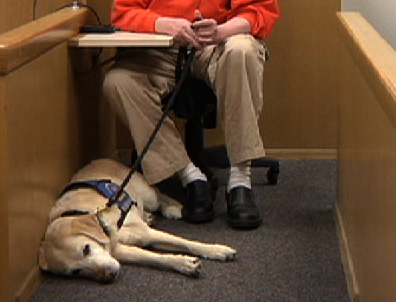
D. Application of Dye to Adult Victim of Domestic Violence
A Washington State Court of Appeals decision issued in May 2014 allowed a “service dog” to accompany an adult victim of domestic violence to the stand when she testified against her husband, Duane Allen Moore, who had been charged with second degree assault with a domestic violence special allegation. In Washington v. Moore, 2014 Wash. App. LEXIS 1186 (May 13, 2014), Moore’s wife, Sabrina Moore, was accompanied during her testimony by a dog named Keris, referred to in the appellate opinion as a service dog, but in the appellant’s brief as a “service or comfort dog.” The dog’s training and its relationship with the witness (i.e., as a facility dog, a service dog, or a pet that provided comfort) received no elaboration either by the appellate court or in the briefs of the parties.
The prosecutor had moved to allow Ms. Moore to be accompanied by the dog because she “was nervous and scared about testifying….” Defense counsel at trial made no objection. The appellate court stated that because the defendant failed to raise at trial any objections regarding the dog’s presence as a violation of his right of confrontation, the issue had not been preserved on appeal absent a showing of constitutional error with “practical and identifiable consequences at trial.” The appellate court found “no evidence in the record that the dog’s presence made Ms. Moore appear traumatized or victimized, and thereby violated Mr. Moore’s due process rights, or acted as a comment on the evidence.” Thus, the failure to object to the use of the dog at trial meant that there was no foundation for an appeal on the issue, which was fatal to defendant’s arguments that the presence of the dog prevented an effective face-to-face confrontation with the witness.
Given that the decision is essentially procedural, it is difficult to say whether Washington has accepted that a dog can accompany an adult witness without establishing any disability other than fear of an abusive husband. If this situation had been accepted as a substantive argument, it would indicate a substantial broadening of the use of facility dogs at trials.
X. FIFTEEN-YEAR-OLD SEXUAL ABUSE VICTIM ACCOMPANIED BY THERAPY DOG WHEN TESTIFYING AGAINST HER FATHER
New York v. Tohom, 969 N.Y.S.2d 123 (N.Y. App. Div., 2d Dept. 2013)
The Appellate Division, Second Department, of the New York Supreme Court ruled that a “therapeutic comfort dog” could provide emotional support to a crime victim during testimony against an individual, Victor Tohom, charged with predatory sexual assault against a child, a felony, and endangering the welfare of a child, a misdemeanor. The acts of sexual misconduct were stated by the prosecution to have occurred from the summer of 2006 to November 2010 with his daughter, who had been born in 1995. During that period, the victim twice became pregnant and the defendant arranged for abortions.
Prosecutors sought, in May 12, 2011, to allow a Golden Retriever named Rose to accompany the child on the witness stand while she testified. Rose had proven useful during interviews and therapy sessions with the child and, according to a therapist, allowed the victim to be “more verbal.” The girl had expressed anxiety about testifying. Her therapist said the dog would help to alleviate the apprehension, as well as reducing the psychological and emotional trauma that might result from testifying against her father.
The prosecutors acknowledged the absence of case law or statutory authority for use of a specialized dog but did note that there was New York precedent for allowing the use of a teddy bear. New York v. Gutkaiss, 206 A.D.2d 628, 614 N.Y.S.2d 599 (App. Div., 3rd Dept. 1994) They also cited Criminal Procedure Law provisions regarding special witnesses and pointed to Executive Law §642-a, which allows a person supportive of a special witness to be “present and accessible” during testimony by such a witness. (This statute is part of Article 23 of the New York Executive Law, Fair Treatment Standards for Crime Victims.)
Defense counsel argued that the dog would prejudice the jury against the defendant and would convey to the jury that the witness was under stress as a result of testifying and that this stress resulted from telling the truth. They also argued that at the time of testifying, the girl was 15 years old, while prior cases “overwhelmingly” involved preteen witnesses. (But see Spence, Dye, Moore, and Chenault, discussed herein.)
A social worker provided some history regarding the victim. The girl had spent the first ten years of her life in Guatemala, where she was raised by her maternal grandparents. At her father’s request, she was sent to the United States and began to live with her father, having “virtually no contact with her mother.” The social worker testified that having the girl testify in open court would retraumatize her.
The prosecution argued that Rose had been trained since the age of eight weeks “to sense stress and anxiety and act in such a way to help reduce” such stress and anxiety by raising herself up and offering herself to the person experiencing them. The defense was willing to allow the social worker to be in the courtroom directly behind the witness stand but requested that the dog be kept out.
A. County Court Ruling
The County court allowed Rose to accompany the victim during testimony, determining that the intent of Executive Law § 642-a is “to protect children under 16 years of age who are victimized by crime,” so use of the dog was appropriate. Before the girl’s testimony, the judge explained to the jury that she would be accompanied by a “companion dog,” but that the jury was not to “draw any inference either favorably or negatively from either side because of the dog’s presence.” The jury was also cautioned in this regard prior to beginning deliberation.
The defendant was convicted on both the felony and misdemeanor charges and sentenced to imprisonment for 25 years to life on the felony and one year of incarceration on the misdemeanor, the sentences to run concurrently. The defense moved to set aside the verdict, basing the motion partially on the fact that the Executive Law did not explicitly allow for the dog’s presence. The County Court denied the motion and the defendant appealed.
B. Issues on Appeal
The defense reiterated some of its objections made at trial on appeal and added others, including arguing that the trial court was required to make a finding of necessity before allowing the use of the dog. The appellate court held that, since this argument was not raised before the County Court, it was “unpreserved for appellate review.” In any case, the argument was found to be without merit because Executive Law § 642-a does not set forth any necessity criterion.
The appellate court agreed that there was no explicit statutory provision allowing for the use of therapeutic comfort animals but noted that the general intent of Executive Law § 642-a addressed “the emotional stress which a child victim might endure as a result of his or her necessary involvement with criminal proceedings.” Although that section speaks primarily of a “child witness,” which is defined in the Civil Procedure Law (190.32(1)(a)) as a person 12 years old or less, there is also a reference to a “special witness,” which is defined (190.32(1)(b)(ii)) as “a person …who is [m]ore than twelve years old and who is likely to suffer very severe emotional or mental stress if required to testify in person concerning any crime….” Elsewhere (CPL 65.00), a child witness is allowed to be as old as 14. Materials accompanying the legislative package that resulted in enactment of § 642-a referred to the provision as covering individuals as old as 16. The appellate court concluded that the County Court correctly ruled that this provision allowed the dog to accompany the victim during testimony.
All four judges of the appellate court panel joined in the opinion of Judge Sandra L. Sgroi. The County Court had agreed with prosecutor that Gutkaiss, where a child witness had been allowed to hold a teddy bear while testifying, was relevant in resolving the legal issues. The appellate court noted similar decisions regarding comfort items and animals in other jurisdictions and stated that—
[W]e perceive no rational reason why, as per the broad dictate of Executive Law § 642-a(4), a court’s exercise of sensitivity should not be extended to allow the use of a comfort dog where it has been shown that such animal can ameliorate the psychological and emotional stress of the testifying child witness.
The defense argued that Rose’s accompaniment of the witness was prejudicial. The appellate court noted that the U.S. Supreme Court had dealt with prejudice in Holbrook v. Flynn, 475 U.S. 560 (1986), where the Court had stated that “if the challenged practice is not found inherently prejudicial and if the defendant fails to show actual prejudice, the inquiry is over.” The appellate court also noted:
[T]he defendant admits that Rose was trained merely to respond to a person's stress level. It is beyond dispute that a dog does not have the ability to discern truth from falsehood and, thus, cannot communicate such a distinction to a jury. Nor can it be concluded that any actual prejudice resulted from the concededly unobtrusive presence of the dog in the courtroom.
There was no discussion as to whether adjustments could have been made to the witness stand to prevent the jury from seeing the dog. In any case, the defendant in the New York case had, according to the appellate court, failed to show that Rose’s presence was inherently prejudicial.
The New York appellate court also summarized Dye (the appellate decision, not the Washington State Supreme Court decision discussed above) and Spence, discussed below, as well as rejecting an argument that the presence of the dog had interfered with the defendant’s right to confront a witness against him. As to an argument made at trial that the County Court should have conducted a Frye hearing to determine that use of the dog in the courtroom had a scientific basis, the appellate court said that this issue had not been preserved for appellate review and was without merit. The court cited an article in which Andrew Leaser had stated: “There is already a significant amount of research showing that the mere presence of a dog can have dramatic emotional and psychological benefits.” Andrew Leaser, See Spot Mediate: Utilizing the Emotional and Psychological Benefits of ‘Dog Therapy’ in Victim-Offender Mediation, 20 Ohio State Journal on Dispute Resolution 943, 961 (2005).
In affirming the judgment of the County Court, the New York appellate court summarized its findings as follows:
Under the circumstances of this case, the County Court properly allowed Rose, the comfort-therapy dog, to accompany the child victim/witness on the witness stand during her testimony. The defendant has not shown that this accommodation was impermissible under Executive Law § 642–a; or that it impaired his right to a fair trial; or that it compromised his constitutional right of confrontation and cross-examination.
This case is largely an interpretation of the latitude allowed a trial judge with a child or special witness under a New York statute, but could be relevant to other jurisdictions considering how broadly to interpret victim protection statutes in allowing facility dogs to accompany victims to the stand.
XI. VICTIM ADVOCATE AND THERAPY DOG ACCOMPANY CHILD ABUSE WITNESS ON STAND
California v. Spence, 212 Cal.App.4th 478, 151 Cal.Rptr.3d 374 (Cal.App.Dist.4, 2012)
James Spence was convicted of sexual offenses involving a child ten years old or younger and sentenced to 55 years to life. Spence had engaged in sexual activities with the daughter of a roommate, for whom he acted as a stepfather. Among arguments he made on appeal was that the trial court erred in allowing, in addition to a support person, a “therapy dog or support canine to be present at the child’s feet while she testified….” The support person was a victim advocate from the District Attorney’s office.
A. Support Person for Witness in California Statutory Law
California Penal Code §§ 868.5 and 868.8 provide, in prosecutions for certain crimes including those involved here, that judges may alter normal courtroom procedures for prosecution witnesses with a disability or who are under eleven years old, including allowing them to be accompanied by a support person. Spence contended that allowing the presence of the therapy dog was “‘overkill’ that unduly focused the jury upon the child’s alleged status as a victim, before any conviction was achieved.”
As to support persons, Penal Code § 868.5 specifically provides:
Notwithstanding any other law, a prosecuting witness [in specified crimes, including molestation] shall be entitled, for support, to the attendance of up to two persons of his or her own choosing, one of whom may be a witness, at the preliminary hearing and at the trial … during the testimony of the prosecuting witness. Only one of those support persons may accompany the witness to the witness stand, although the other may remain in the courtroom during the witness’ testimony. (emphasis added)
The court briefly discussed the terminology regarding the dog in the case:
The court and parties at trial referred to the dog as a courtroom or canine therapy dog. Although the Attorney General now prefers to use the term “courthouse facility dog,” and seeks to have us address victim protection issues in a wider context, we need not and cannot expand the record and the issues in that way. Since the term “canine therapy dog” is somewhat redundant, we will refer to the dog in this case as a therapy dog or a support canine.
B. Prosecutor Requests Use of Both Support Person and Therapy Dog
The prosecutor requested that the therapy dog and the victim advocate accompany the child to the witness stand because “Spence's family was going to be present and there were concerns that D. might have an emotional meltdown and refuse to testify, since it could be a terrifying situation for her.” Defense counsel suggested that the victim advocate and the therapy dog be kept nearby, perhaps in the jury room.
The appellate decision described the trial court’s approach to the question of prejudice in the use of a specialized dog during a trial:
[The trial court] commented that there would be no prejudice in allowing the therapy dog to be present in the courtroom. The court said it was comparable to D. holding a “cute teddy bear in her hands” to provide her comfort. The court explained to counsel that this particular therapy dog had been in the same courtroom before, “and she's almost unnoticeable once everybody takes their seat on the stand. She's very well-behaved and does nothing but simply sit there. And so if that does make it easier for [D.] to testify, I am going to allow it.” However, if any issues or improper behavior by the therapy dog occurred, it would be removed from the courtroom. The record does not show any such problems arose.
The jury was informed that the child witness would be entering through the back door rather than the front entrance to the courtroom. The prosecutor noted for the record that the witness would be “accompanied by a victim advocate named Norie Figueroa from our office and a canine therapy dog.”
C. California Appellate Review
The California appellate court referred to the Washington State appellate decision in Dye (i.e., the decision that was affirmed by the Washington Supreme Court, as discussed above), noting some factors in that case that were relevant to the prosecution of Spence:
The court relied on several factors to find there was no error in that procedure, such as: (a) the court's discretion to control courtroom proceedings and witness examination, (b) the absence of any claim of interference by the dog's presence with the defendant's right to confront and cross-examine the victim-witness; (c) the lack of any indication the dog's presence alone communicated to the jury any presupposition of this witness's “very victimhood;” (d) the absence of any indication there had been any improper gifts or favors in this respect from the prosecutor to the victim-witness.
The California appellate court also noted that the trial court in Dye had instructed the jury not to make any assumptions or draw any conclusions from the presence of the service dog. The Washington appellate court analogized the presence of the therapy dog to the use of stuffed animals by child victims in sexual abuse cases, but the California appellate court declined “to use that analogy in this case, which presents a more specialized issue.” Thus, not all courts have accepted analogies of facility dogs to stuffed animals, toys, or blankets. (Recently, a Washington appellate court analogized a child holding a copy of her mother’s driver’s license on the stand to testifying while accompanied by a facility dog. Washington v. Park, No. 722622-o-I, 2015 WL 7300788 (Ct. App. 2015).)
In considering whether allowing both a therapy dog and a victim advocate to accompany a witness to the stand contravened Penal Code § 868.5, quoted above, the court noted:
[I]t is easy to conclude that therapy dogs are not “persons” within the meaning of section 868.5, setting limitations on the number of “persons” who may accompany a witness to the witness stand. Moreover, since subdivision (b) of section 868.5 refers to the court's duty to give admonitions under section 868.5 that the advocate must not sway or influence the witness, we cannot imagine that the Legislature intended that a therapy dog be so admonished, nor could any dog be sworn as a witness in this context, so as to invoke the limitation on the number of support persons who may accompany a testifying witness to the stand. In any case, the trial court took care to ensure that the therapy dog would be mainly unnoticeable once everybody took their seats, and that corrective action would be taken if there was a problem, which there was not.
Therefore, the court found that the Penal Code did not preclude the use of a therapy dog with a child witness and that allowing the dog to be present during the child’s testimony was within the trial judge’s discretion. The court found no prejudicial error or abuse of discretion. Rejecting other assignments of error, the conviction was affirmed.
The California decision is based in significant part on specific statutes that will not apply in other states. Nevertheless, for states that have allowed, whether by statute or under general concepts of judicial latitude, trained individuals to accompany children or vulnerable witnesses during testimony, this case provides effective arguments regarding the additional presence of a facility dog.
D. Habeas Petition Denied
A 2015 habeas petition by Spence failed in the federal district court for the Southern District of California, Spence v. Beard, No. 14cv1624-BAS, 2015 U.S. Dist. LEXIS 56280 (SD Cal. 2015). Spence claimed he had been denied due process when the trial court allowed the child to have both a therapy dog and a support advocate accompany her to the witness stand during her trial testimony. The federal district court found this argument without merit, noting that it appeared from the record that the dog sat at the child’s feet and “was unobtrusive.” There was no showing that the presence of the therapy dog adversely influenced the jury, and there was no evidence that use of the dog “so fundamentally infected the trial process as to violate the petitioner’s due process rights.”
XII. HAWAII STATUTE REQUIRES DOG TO BE TRAINED TO PROVIDE EMOTIONAL SUPPORT TO WITNESSES TESTIFYING IN JUDICIAL PROCEEDINGS
As already mentioned, statutes on facility dogs, as with cases, will be discussed from most recently enacted so that readers familiar with prior versions of this article will not have to read through previously included materials to get to the latest developments.
Hawaii [H.B. 1668, signed by Governor Ige into law 6/30/2016 as Act 178, code location not final as of this writing] provides that a facility dog “is a graduate of an assistance dog organization that is accredited by Assistance Dogs International or similar internationally recognized organization whose main purpose is to grant accreditation to assistance dog organizations based on standards of excellence in all areas of assistance dog acquisition, training, and placement.” There would seem to be no organizations that meet this definition other than ADI. Further, a facility dog “shall be specially trained to provide emotional support to witnesses testifying in judicial proceedings without causing a distraction during the proceedings.” This additional component might mean that many ADI trained dogs would not qualify, and it is not clear to the author at this time that this provision would apply to any organization other than Courthouse Dogs, Inc. Hawaii may have effectively given a monopoly to a single organization within ADI.
The Hawaii statute also defines a vulnerable witness as one ”whose ability to testify in a judicial proceeding will be hampered or ineffective without the assistance of a facility dog, for reasons including but not limited to intellectual or emotional disability, intimidation, or age.” The wording is unique in not contemplating the use of a support person or other mechanism for allowing the witness to testify. The court, however, must determine "that there is a compelling necessity for the use of a facility dog to facilitate the testimony of the vulnerable witness.” The author has been advised that the phrase “compelling necessity” in the legislation was taken from Hawaii v. Palabay, 9 Haw. App. 414, 844 P.2d 1 (Ct. App. 1992), in which an appellate court determined that there had to be a compelling necessity to allow a child to hold a teddy bear while testifying, though the appellate court affirmed upon determining that the jury was not swayed by the “brief presence of the stuffed animal” and this and all other errors assigned “were harmless beyond a reasonable doubt.”
The moving party is also to file a motion certifying to the court:
(1) The credentials of the facility dog;
(2) That the facility dog is adequately insured; and
(3) That a relationship has been established between the witness and the facility dog.
The court may “[t]o the extent necessary … impose restrictions, or instructions to the jury, regarding the presence of the facility dog during proceedings.”
XIII. ARIZONA STATUTE ASSUMES JURY INSTRUCTION WILL AVOID ANY BIAS
Arizona has revised both its statutory titles concerning child safety and criminal law (specifically regarding crime victims’ rights) to require that courts accept facility dogs in some cases and allow them to do so in others.
Under Arizona Revised Statutes 8-422D (child safety) and 13-4442D (victims’ rights), a facility dog is “a graduate of an assistance dog organization that is a member of an organization or entity whose main purpose is to improve the areas of training, placement and utilization of assistance dogs, staff and volunteer education and to establish and promote standards of excellence in all areas of assistance dog acquisition, training and partnership.” Thus, the statute requires that a facility dog be trained by one organization that is a member of another, and that both of them be concerned with “assistance dogs,” which would seem very likely to exclude therapy dog organizations, first because most therapy dogs are not trained by organizations but rather by individuals not organized as legal entities, and second, because national therapy dog organizations are not directly involved in the “training, placement and utilization” of therapy dogs, but rather with their certification.
In order to have a facility dog accompany the victim during testimony, ARS 8-422A and ARS 13-4442A require that the party seeking the use of the dog “must file a notice with the court that includes the certification of the facility dog, the name of the person or entity who certified the dog and evidence that the facility dog is insured.” Interestingly, ARS 8-422A and ARS 13-4442A state that the “court shall allow a victim who is under eighteen years of age to have a facility dog, if available, accompany the victim while testifying in court,” while ARS 8-422B and ARS 13-4442B say that for a victim who is 18 years of age or more, or for a witness, the court “may allow” use of a dog. Thus, allowing the use of the dog with a witness 18 or over is always discretionary, but with a victim under 18 years old, the court must allow use of the dog.
The statute requires that the court must instruct the jury on the role of the facility dog and explain that the dog is a trained animal. The purpose of such an instruction is specifically stated, in ARS 8-422C and ARS 13-4442C, as being “to ensure that the presence of a facility dog assisting a victim or a witness does not influence the jury or is not a reflection on the truthfulness of any testimony that is offered by the victim or witness.” Thus, the statute assumes that an instruction can avoid any bias that the presence of the dog might have, something that has not been verified by adequate research.
XIV. OKLAHOMA STATUTE ALLOWS USE OF CERTIFIED THERAPY DOGS
In April 2014, Oklahoma revised Title 12, section 2611, of its Civil Procedure statutes to include provisions regarding the presence of a “certified therapeutic dog” during testimony. Under section 12-2611.2F, minor or incapacitated witnesses have the right to be accompanied by a support person while testifying, but: “In lieu of a support person, a witness shall be afforded the opportunity to have a certified therapeutic dog accompanied by the handler of the certified therapeutic dog pursuant to the provisions set forth in Section 1 of this act.” Section 1 of the Act (House Bill No. 2591) includes the definitional provisions regarding the dog and the witness, as well as stating the Oklahoma Legislature’s intent to “recognize the special circumstances and needs of a child witness during criminal court proceedings, and to protect the child witness from any unnecessary emotional discomfort or anguish.” Under Oklahoma Statutes 12-2611.12C, a “child witness shall be afforded the opportunity, if available, to have a certified therapeutic dog in lieu of a support person.”
Oklahoma Statutes 12-2611.2D.1 defines a “certified therapeutic dog” as follows:
“Certified therapeutic dog” means a dog which has received the requisite training or certification from the American Kennel Club, Therapy Dogs Incorporated, or an equivalent organization to perform the duties associated with therapy dogs in places such as hospitals, nursing homes, and other facilities where the emotional benefits of therapy dogs are recognized.
The reference to the AKC is curious. Although the AKC website on therapy dogs indicates that the organization has titles, the website specifies that “AKC does not certify therapy dogs; the certification and training is done by qualified therapy dog organizations. The certification organizations are the experts in this area and their efforts should be acknowledged and appreciated.” There are a number of national and regional organizations listed by the AK (http://www.akc.org/events/title-recognition-program/therapy/organizations/).
Under Oklahoma Statutes 12-2611.2D.2, a child witness “means an individual younger than thirteen (13) years of age who has been or will be called to testify in a criminal proceeding . . .” Although the statute’s introductory provision refers to incapacitated witnesses as well as minors, the specific provisions regarding therapeutic dogs do not mention anyone but child witnesses.
Oklahoma Statutes 12-2611.2D.1 continues with a procedural requirement:
Prior to the use of a certified therapeutic dog the court shall conduct a hearing to verify:
a. the credentials of the certified therapeutic dog,
b. the certified therapeutic dog is appropriately insured, and
c. a relationship has been established between the child witness and the certified therapeutic dog in anticipation of testimony . . .
According to an AKC information line, the AKC does not provide insurance for therapy dogs. Of course, the organizations listed by the AKC generally do. Note that the statute anticipates contact between the child witness and the therapeutic dog.
XV. ILLINOIS STATUTE ALLOWS JUDGES TO SET CONDITIONS FOR USE OF DOGS IN SEX CRIME PROSECUTIONS; SPECIFIES DOGS MUST BE GRADUATES OF ADI-MEMBER PROGRAMS
In July 2015 Illinois adopted Public Act 99-0094, amending Article 106B of the state’s Code of Criminal Procedure, which concerns victims of sexual abuse. New Section 106B-10 of that Article provides “Conditions for testimony by a victim who is a child or a moderately, severely, or profoundly intellectually disabled person or a person affected by a developmental disability.” The new provision states that in taking the testimony of such an individual, a court may set conditions “involving the use of a facility dog in any proceeding involving” certain offenses, specifically “criminal sexual assault, predatory criminal sexual assault of a child, aggravated criminal sexual assault, criminal sexual abuse, or aggravated criminal sexual abuse.” A judge considering whether to permit “the child or person to testify with the assistance of a facility dog” is to take into consideration “the rights of the parties to the litigation, and any other relevant factor that would facilitate the testimony by the child or the person”
The final sentence is very specific as to what kind of dog can be used: “As used in this Section, ‘facility dog’ means a dog that is a graduate of an assistance dog organization that is a member of Assistance Dogs International.” Note that this wording does not require that the dog be trained to be a facility dog, to assist a child or “intellectually disabled person,” but rather that the dog is a graduate of an organization that is a member of ADI. Thus, a dog trained to be a hearing dog, a mobility impairment dog, or for any other kind of assistance work recognized by programs that are members of ADI would appear to satisfy the statutory requirement.
If an organization must be a member of Assistance Dogs International to train a dog that can be used in a courtroom under the new provision, judges may at some point be asked to accept dogs that have been trained by organizations that are not full members of ADI, but rather candidate members. In this connection it may be worth noting that when the Department of Veterans Affairs proposed rules specifying that the agency’s funding of service dogs for veterans would be restricted to dogs trained by ADI member organizations, I had asked, in commenting on the proposal, whether dogs trained by candidate organizations could satisfy VA requirements. The VA, in the preamble to the final regulations replied: “We clarify for one commenter that VA only intends to recognize those service dog organizations that have full membership in ADI or IGDF, or that are fully ADI or IGDF accredited, versus those organizations in the process of becoming ADI or IGDF accredited” (77 Fed. Reg. 54368, 54372, September 5, 2012). Defense counsel should consider this issue if objections are raised concerning the use of a dog during testimony in Illinois.
XVI. ARKANSAS STATUTE REQUIRES TWO YEARS OF TRAINING WITH SPECIAL EMPHASIS ON WORK IN COURT
In April 2015, Arkansas adopted Act 957, The Courthouse Dogs Child Witness Support Act, which added section 16-43-1002 to code provisions regarding the testimony of minors and providing for the use of facility dogs with child witnesses. A “certified facility dog” has:
(A) Graduated from a program of an assistance dog organization that is a member of Assistance Dogs International or a similar nonprofit organization that attempts to set the highest standard of training for dogs for the purpose of reducing stress in a child witness by enhancing the ability of the child witness to speak in a judicial proceeding by providing emotional comfort in a high stress environment;
(B) Received two (2) years of training; and
(C) Passed the same public access test as a service dog.
The wording of (A) follows the webpage standards provided by Assistance Dogs International (http://www.assistancedogsinternational.org/standards/assistance-dogs/standards-for-dogs/training-standards-for-facility-dogs/), although ADI’s facility dog training standards do not, at least on the webpage, contain a two-year training requirement. It is to be noted that therapy dogs that are, with their handlers, registered as teams with national therapy dog organizations, can begin work after passing a qualification test, which many do without having received two years of training. Although the author’s dog, registered with the author by a national therapy dog organization, did receive two years of training, about half of that was after passing the test. Also, the training was not “for the purpose of reducing stress in a child witness…”, so most therapy dogs would not qualify as facility dogs under Arkansas statutory law.
Therapy dogs would also be excluded under the requirement that a certified facility dog has to have “[g]raduated from a program of an assistance dog organization that is a member of Assistance Dogs International or a similar nonprofit organization….” Although some therapy dogs may graduate from some kind of program, most will just take enough obedience classes to pass the test of a national registering organization. Also, most will not take classes from an organization that is a member of either ADI but rather from individual obedience trainers who are often not affiliated with any organization. Even if they are, most national therapy dog registering organizations certify individual trainers much more often than certifying organizations that become high dues-paying members, the way ADI operates.
A. Handler Requirements
Act 957 also provides handler requirements:
“Certified handler” means a person who has received training from an organization accredited by Assistance Dogs International, the American Kennel Club, Therapy Dogs Incorporated, or an equivalent organization on offering the person's animal for assistance purposes and has received additional training on the protocols and policies of courts, the expected roles of the person's animal assistance team, and the expected interaction so as not to interfere with the collection of evidence or the effective administration of justice….
Thus a handler who has received training from ADI, TD Inc., or an equivalent organization (presumably a guide dog organization or the other national therapy dog organizations), would have to get “additional training on the protocols and policies of courts, the expected roles of the person’s animal assistance team, and the expected interaction….” As worded, this at least indicates that the dog and the trainer do not necessarily need to have the same background in training. Thus, a dog trained by an ADI-member organization could presumably be paired with a handler whose education in handling dogs was a therapy dog organization. This may envision a situation where dogs will be trained by ADI members as a commercial activity, but made available to purchase by individuals interested in providing such facility dog services in various regions of the country, with those handlers sometimes trained as therapy dog handlers. Whether a handler who happens to be a lawyer (such as the author) could qualify is unclear, though as already noted, the author’s therapy dog would not qualify as a “certified facility dog” in any case.
The Act also defines “child witness:”
“Child witness” means a witness testifying in a criminal hearing or trial whose age at the time of his or her testimony is eighteen 11 (18) years of age or younger.
B. Motion to Allow Use of Facility Dog
The Act concerns only criminal trials. A child witness in a civil suit against the perpetrator of an abuse would not seem to have any right under the statute. The statute provides that under certain circumstances a child witness is to “be afforded the opportunity to have a certified facility dog accompany him or her while testifying in court.” The circumstances are (1) a request by either party in a criminal trial or hearing, and (2) the availability of a certified facility dog in “the jurisdiction of the judicial district in which the criminal case is being adjudicated.” This would not seem to exclude bringing in a facility dog from another state, provided the dog and presumably the handler could be determined to be in the criminal court’s jurisdiction at the time of the testimony. The party (i.e., prosecution or conceivably defense) seeking to use the dog with a child witness is to file a motion with the court certifying the following:
(1) The credentials of the certified facility dog;
(2) That the certified facility dog is adequately insured;
(3) That a relationship has been established between the child witness and the certified facility dog in anticipation of testimony; and
(4) That the presence of the certified facility dog may reduce anxiety experienced by the child witness while testifying in the criminal trial or hearing.
Note that the dog would at least have to be in the criminal court’s jurisdiction long enough to have established a relationship with the child witness, which presumably would have to be at least several days if not a week. If a dog is to be brought in from another region of the country, the handler would presumably also be from that other region of the country, and the expense could be considerable. The Act seems to anticipate that such a handler-dog team will begin to be a profession for certain individuals who, with their dogs, expect to be used regularly for this type of work.
Although the author’s coverage under the policy of a national therapy dog organization would probably satisfy the insurance requirement, anyone who gets into the practice of offering such a service with a dog should verify with the insurance company that this would fall within a policy that might be intended to cover other types of incidents. The relationship requirement would mean that the facility dog would have to start working with the child or children involved prior to testifying.
It is perhaps worth noting that the Act specifies that either the prosecution or the defense might have use for a facility dog at trial. Some courts have also alluded to such a possibility. Although all opinions have so far concerned dogs used with prosecution witnesses, it is not inconceivable that a child witness for a defendant might have difficulty testifying, perhaps in a situation where someone else might have been responsible for the crime than the defendant, or to testify that the defendant’s involvement in the crime was minor. If the dog is the property of the police or a prosecutor, or within a system primarily known to prosecutors, it must be wondered how easily arrangements will be made.
C. Jury Precautions
The Act specifies certain precautions with regard to the jury. “The jury shall be seated subsequent to the child witness and certified facility dog taking their places in the witness stand.” This is likely designed to assure that the dog is as unobtrusive as possible. There are two more requirements with regard to juries:
(e) In the course of jury selection, with the court’s approval under [Arkansas voir dire rules], either party may voir dire prospective jury members on whether the presence of a certified facility dog to assist a child witness would create undo sympathy for the child witness or in any may serve as a prejudice to the defendant.
(f) In a criminal trial involving a jury in which the certified facility dog is utilized, the court shall present appropriate jury instructions that are designed to prevent prejudice for or against any party.
The ability to voir dire prospective jurors with regard to their reaction to a dog appearing with a child witness indicates that the statute is not requiring that dogs in witness boxes should be invisible wherever possible.
XVII. FLORIDA STATUTE ON USE OF SERVICE AND THERAPY ANIMALS AS WITNESSES
In 2012, Florida added a provision (Florida Statutes 92.55) regarding service and therapy animals to its evidentiary code, which were revised in 2014. The provision allows a court to provide special protections for a “victim or witness under the age of 16, a person who has an intellectual disability, or a sexual offense victim or witness” on its own motion or on the motion of any party, a parent, guardian, attorney, or guardian ad litem “to protect the victim or witness in any judicial proceeding or other official proceeding from severe emotional or mental harm due to the presence of the defendant if the victim or witness is required to testify in open court.” In addition to other kinds of relief that might be granted (limiting the number of interviews of the victim or witness, prohibiting depositions, requiring submission of questions in advance, etc.), the statute states:
The court may set any other conditions it finds just and appropriate when taking the testimony of a child victim or witness or a sexual offense victim or witness, including the use of a service or therapy animal that has been evaluated and registered according to national standards, in any proceeding involving a sexual offense. When deciding whether to permit a child victim or witness or sexual offense victim or witness to testify with the assistance of a registered service or therapy animal, the court shall consider the age of the child victim or witness, the age of the sexual offense victim or witness at the time the sexual offense occurred, the interests of the child victim or witness or sexual offense victim or witness, the rights of the parties to the litigation, and any other relevant factor that would facilitate the testimony by the child victim or witness or sexual offense victim or witness. [emphasis added]
It is not clear what is meant by being evaluated and registered according to national standards. This may mean that the animal would be registered with an organization, such as Therapy Dogs International or a member organization of Assistance Dogs International, i.e., organizations that have national reach in their membership. The training standards of such groups as Pet Partners (formerly Delta Society), Therapy Dogs International, and Therapy Dogs Inc. are similar but not identical.
Florida Statutes 413.08 define “service animal” for purposes of the misdemeanor of interference with the use of such an animal, though the term “therapy animal” is not defined outside of the evidentiary statute just discussed. Since the posting of the last version of this article, the definition of service animal in FS 413.08 has been revised to conform to the 2010 regulations of the Department of Justice. The definition now reads as follows:
“Service animal” means an animal that is trained to do work or perform tasks for an individual with a disability, including a physical, sensory, psychiatric, intellectual, or other mental disability. The work done or tasks performed must be directly related to the individual’s disability and may include, but are not limited to, guiding an individual who is visually impaired or blind, alerting an individual who is deaf or hard of hearing, pulling a wheelchair, assisting with mobility or balance, alerting and protecting an individual who is having a seizure, retrieving objects, alerting an individual to the presence of allergens, providing physical support and assistance with balance and stability to an individual with a mobility disability, helping an individual with a psychiatric or neurological disability by preventing or interrupting impulsive or destructive behaviors, reminding an individual with mental illness to take prescribed medications, calming an individual with posttraumatic stress disorder during an anxiety attack, or doing other specific work or performing other special tasks. A service animal is not a pet. For purposes of subsections (2), (3), and (4), the term “service animal” is limited to a dog or miniature horse….
This definition, although it might not be relied upon by a court in issuing an order protecting a victim or witness in a sexual offense prosecution, raises the interesting possibility that service and therapy horses might be used in a courtroom setting. Miniature horses have been used as service animals, particularly as guides for the visually impaired, for at least a decade and several therapy animal organizations have registered miniature horses for therapy assignments.
The definition of “service animal” does not specify a national standard though, when used by the Department of Justice, the term “service animal” has national application. Thus, the national standard requirement is unique to the courthouse setting in which the animal is to be used. Presumably, a training regimen of an organization with some national recognition would be superimposed on the definition. Given the attitudes of some of the training organizations towards each other, it is to be hoped that Florida judges will be reasonably open to those organizations that have been effective in training service or therapy animals over a significant period of time.
XVIII. SERVICE DOGS USED BY NON-WITNESS PARTICIPANTS IN TRIALS
In considering possible disruptions that can occur because of the presence of a dog in a courtroom, a few cases involved dogs being used by non-witness participants in trials. A case decided by the Court of Appeals for the District of Columbia mentioned that a prosecutor had been allowed to use a guide dog and that there had been no objection. The appellate court remarked that “there appears to have been no evaluation whether the presence of the prosecutor’s guide dog and paralegal presented an ‘overriding interest that is likely to be prejudiced’….” The fact that the court considered the possibility of prejudice from the presence of the dog, though neither the defense counsel nor the trial court had done so, may indicate some concern that a prosecutor’s use of a guide dog could be prejudicial. Williams v. U.S., 2012 WL 4006414 (D.C. Ct. of Appeals, 2012).
Press reports have described a chief crime scene investigation supervisor who has testified with her guide dog. (http://www.ncsilc.org/2011/08/30/blind-csi-investigator-honored-by-tv-counterparts-in-marin/) Whether there have been objections to such an appearance by a dog was not stated, but it might be argued that the defense might actually find the proof of the witness’s blindness helpful in cross-examination.
In Leigh v. Florida, 58 So.3d 396 (2011), the judge’s dog was visible to the jury and apparently disruptive:
[T]he jury was aware of the presence of a dog in the courtroom because, on more than one occasion, the presiding judge, the Honorable Susan Lebow, had to correct her dog, which was whining and barking, and on more than one occasion, the dog put its front paws on the swing door that separated it from the courtroom where the judge was presiding, suggesting to the jury that the dog was present for the safety of the court, unnecessarily marking Defendant as a dangerous character.
The Florida appellate court reversed and remanded, with a provision that the trial court could attach portions of the record that would refute the possibility that defense counsel’s failure to object to the dog’s presence indicated ineffective assistance of counsel. Since there was apparently no evidence of the dog’s presence in the record at all, the trial court was presumably obligated to conduct an evidentiary hearing on the matter. Nevertheless, this raises the issue that a disruptive dog, at least one that might be interpreted as guarding a witness or judge, could improperly influence a jury.
XIX. SERVICE AND EMOTIONAL SUPPORT ANIMALS COMING WITH WITNESSES
In issuing regulations applicable to state and local governmental facilities under the Americans with Disabilities Act, with specific mention of service animals, the Department of Justice noted in a preamble that courthouses were covered facilities to which service animals would be admitted. (Department of Justice, Nondiscrimination on the Basis of Disability in State and Local Government Services, 75 Fed. Reg. 56164, September 15, 2010.) These references were not specific to courtrooms, much less entering a courthouse for the purpose of being a witness in a criminal matter, and could not be said to impose a blanket requirement on a judge to allow a witness to testify while accompanied by a service animal. Nevertheless, the purpose of the rules could be applied to a witness with a mental disability for which the individual uses a service dog. If, for instance, and individual with PTSD has a tendency to enter an uncommunicative state in situations of stress, and uses a dog in part to reduce the likelihood of this happening, then a strong argument could be made that such an individual should be allowed to remain accompanied by the service dog while testifying. This situation is somewhat analogous to Dye, except that the dog is owned or used on a regular basis by the witness, rather than being supplied on a temporary basis by the prosecutor’s office.
A somewhat more difficult case would involve a dog that is not a service dog but that provides emotional support for an individual with a mental condition. Such dogs, if not trained at the level required to be designated a service animal (28 C.F.R. 35.104, 35.136), would not have access privileges under the Department of Justice regulations applicable to state and local government facilities. Nevertheless, such animals are recognized as having access to airline cabins, in part because the Department of Transportation has acknowledged their value for passengers with documented anxiety or psychological conditions who use such dogs to manage the stress of flying. (14 C.F.R. 382.27, 382.117; the Department of Transportation has recently indicated that the emotional support provision may be reviewed).
Should such an argument justify admitting an emotional support animal—a pet from the perspective of the Department of Justice—into a witness box? Because of the lack of training required for a service animal, or presumably for the kind of facility dog used in Dye, the dog might not be as inconspicuous as a judge might desire. Nevertheless, if the judge could be assured that the animal would not be disruptive, should it be allowed in the courtroom? Or does this open the floodgates to anyone with some anxiety about being in front of a room of people to bring in a pet, as may have been the case Moore, discussed above? The witness could be required to provide evidence of the condition that necessitates recognition of the animal as distinct from a pet for this purpose, but whether a court would take such an approach will probably have to wait until an actual case arises.
Some of these issues appeared in a recent California case, In re Alameda County Social Services Agency v. Sabrina H; Sabrina H. v. The Superior Court of Alameda, 2015 Cal. App. Unpub. LEXIS 6400. Here, a juvenile court prevented a mother from bringing a “comfort dog” into the courtroom during hearings on her parental rights. The California appellate court’s summary of this aspect of the case indicates that the dog had been allowed in for several hearings, but had somehow “become an issue.” Citing concerns about the length of the full-day trial and the lack of evidence that mother's dog had any specific training to deal with physical or psychological disabilities, the juvenile court judge gave mother the choice of leaving the dog outside or declining to participate in the hearing. The mother chose to leave the courthouse with her dog.
The juvenile court had requested documentation that the dog was “a service dog rather than an untrained emotional support animal,” and the mother “claimed that she previously had a service dog identification card, but had lost it.” The juvenile court judge stated that “a service dog, as the Court understands it, is a dog that has specific training and has training to deal with whatever the problem may be with its owner, be it psychological, physical, something of this nature. A support dog is a dog that provides psychological support or other types of support for the owner but does not have specific training.” The appellate court also indicated that the mother could have brought someone to keep the dog outside the courtroom so that, apparently, she could have access to it during breaks in court proceedings. The appellate court affirmed the juvenile court’s requirement that there be “appropriate paperwork.” Although an argument could be made that the insistence on documentation by the two courts was misplaced, if the dog had been disruptive, thereby raising a question as to whether it had specific training as to a disability, the juvenile court could appropriately seek evidence that the dog was a service animal. Misbehavior in the courtroom setting would have been strong evidence that the dog was not trained as a service animal, appropriately shifting to the mother the burden of establishing that it was.
It should be noted that the presence of a service dog might also produce an element of bias in a judge or jury. In a study of the effects of service dogs for children with disabilities published over 25 years ago, Mader, Hart, and Bergin considered whether “disabled children in wheelchairs with service dogs receive more frequent social acknowledgment than when no dog is present.” They found that children with service dogs receive “friendly glances, smiles, and conversations” more frequently when a service dog is present. Further, they found such social effects “were more pronounced in shopping malls, typical of unfamiliar settings where the child would be likely to experience being ignored or overlooked.” Bonnie Mader, Lynette A. Hart, and Bonita Bergin, Social Acknowledgments for Children with Disabilities: Effects of Service Dogs. 60(6) Child Development 1529 (1989). Although not a courtroom study, these results may indicate that the presence of a service dog could alter a jury’s “social acknowledgment” of a child witness, so further research should be undertaken to determine whether this social acknowledgment might extend to a jury’s perception of a child’s veracity.
XX. FINAL OBSERVATIONS AND CONCLUSIONS
A number of additional states have been considering legislation to permit the use of facility dogs with children and disabled witnesses, and several of the cases discussed above are primarily concerned with determining whether the use of a dog by a child or vulnerable witness during a prosecution was acceptable under state child- or vulnerable-witness statutes. A uniform law might be difficult to draft given that many states have different approaches on judicial latitude with regard to vulnerable witnesses, and uniformity on facility dogs might be difficult to anchor across such a broad range of statutory structures. Also, it is the author’s opinion that additional judicial experience regarding the types of cases where facility dogs are appropriate, the types of witnesses for whom they are appropriate, and the range of dogs that should be permitted in the witness stand should be allowed to develop further inside of American judicial experience before imposing legislative uniformity.
A. Targeted Research Needed
Although there is a place for facility dogs in the testimony of children and vulnerable witnesses, trial courts, and some appellate courts, have been too easily enamored of the prospect of improving the chances that the witness will feel free to speak without considering that a jury might assume that the presence of the dog allowed to child to speak truth where the child would otherwise not speak at all or would suppress the truth. This should be a subject of scientific inquiry by criminologists and psychologists, and for those various disciplines studying the effects of animals on human psychology. Such research might involve a survey of members of juries that have heard testimony where facility dogs and service animals accompanied witnesses. The study should determine not only whether the presence of the animal affected the juror’s vote, but also whether other reactions and impressions of a juror might indicate the existence of a more subtle, perhaps unconscious, bias. Psychological studies should also be undertaken to determine if children or individuals with different disabilities remember more about an incident in the presence of a dog, or remember what happened more accurately.
Writing almost a century ago, Judge McWhorter of West Virginia wrote that “bloodhound testimony” seemed to exert a “superstitious awe in juries,” which courts were satisfied they had neutralized “with admonitions of great caution….” J.C. McWhorter, The Bloodhound as a Witness. 54 American Law Review 109 (1920). Those states that have rejected tracking evidence were, according to a Maryland court, primarily concerned with the effect such testimony can have on a jury. Terrell v. Maryland, 3 Md.App. 340, 239 A.2d 128 (Ct.Spec.App. 1968). The Maryland appellate court noted that the bloodhound’s supposed reliability, along with “local prejudice and public indignation and excitement may exert undue influence on the jury,” and that “the mere use of the dogs will arouse the public’s excitement with the result of prejudicing the defendant.”
More recently, a California appellate court agreed with the defense that the presence of a trailing dog in the courtroom during the handler’s testimony was “more prejudicial than probative and violated his due process right to a fair trial.” The dog was apparently in the courtroom because the handler and dog were “due to leave on a trip together.” The court stated that “Inga’s presence likely generated sympathy for Garvin and bias against defendants.” Nevertheless, the court found sufficient other evidence of guilt to label this harmless error. California v. Oudin, 2015 Cal. App. Unpub. LEXIS 4147 (June 12, 2015).
A dose of the kind of skepticism expressed by Judge McWhorter and these courts would be appropriate with regard to facility dogs in courtrooms, and introducing such skepticism should at times be an objective of defense counsel. In a number of the cases described above, defense counsel failed to make timely or appropriate objections to the use of the dog, or seemed to have researched key issues only for an appeal, making it easy for an appellate court to declare whatever error may have been involved was minor or was being raised too late.
B. Dog Should Be Inconspicuous
Courts have not always adequately considered whether the presence of a facility dog could be hidden from the jury, or whether it should be. Expecting that a dog would have to show overt behavior towards a defendant, as was suggested by the Washington State Supreme Court in Dye, is naïve. A dog is unlikely to react to a defendant sitting quietly beside defense counsel merely because the defendant is a cause for a child’s nervousness. In any case, the witness’s anxiety may be to the courtroom and the number of people in it rather than to only one person sitting many feet away, as was indicated in Chenault. The prejudice that could arise in the jury from the presence of the dog would more likely come from a witness’s constant attention to it, giving the impression that the witness is unburdening himself or herself to the animal in a catharsis that leaves no room for fabricating lies. Courts should therefore consider how best to limit the jury’s perceptions regarding the significance of a dog during testimony. A jury instruction may not be enough given that the human-animal bond, particularly with regard to dogs, is in some way elemental to the relationship we have had for thousands of years and could cross the courtroom to connect the dog to some members of the jury.
Thus, it is not merely that temporary relationship between a witness and a dog brought in to calm and comfort the witness that should be of concern to a judge. Just as a witness with a prosthetic device could be required to limit the visibility of the device during testimony in a negligence trial where the liability concerns circumstances under which the witness had to begin using the device, so here an effort should be made to limit the jury’s attention to a witness’s vulnerability. The record should at least establish that a trial court understood such issues and attempted to address them in a fair-minded and logical manner in the case being heard. As the phenomenon of facility dogs in courtrooms is becoming more common, this issue should also be considered in the construction of witness boxes.
Part of a court’s concern with the dog being inconspicuous is that any handler present should also be as inconspicuous as possible. One commenter has argued that dogs that have to be accompanied by a handler would present a problem for a court, as:
Having a trained handler accompany the dog likely would be a distraction for jury members, who may spend time studying the handler rather than paying close attention to the testimony. Also, because the dog would be under control of the handler, the witness may not have the sense of empowerment that comes with holding a dog’s leash and walking up to the stand alone with a dog under his or her control.
Gabriela N. Sandoval, Court Facility Dogs—Easing the Apprehensive Witness, 38 The Colorado Lawyer 17 (April 2010) (citing Pet Therapy Dogs in the Criminal Justice System, http://www.courthousedogs.org/pdf/CourthouseDogs-PetTherapyDogs.pdf). The presence of a handler in addition to the dog would presumably be a factor a court should consider in determining the appropriateness of the use of the dog. Sherri Minhinnick, a professional trainer and handler working in several states, advises the author that, in being brought into cases by psychologists involved in child sexual abuse cases, part of her responsibility has become “to instill enough confidence to allow the child to become a temporary and casual handler for the support animal.” She visits the courtroom where the child will testify with the child and the dog and the child will often gain enough confidence to handle the dog during the testimony that Minhinnick’s role “becomes that of courtroom observer rather than tangential participant during the testimony.” In some instances, the child gains enough confidence through this kind of work that the dog will “not even need to be present in the courtroom” when the child testifies.
C. Witness Categories Appropriate for Facility Dogs
As to the witness, there may be some categories, such as children below the age of 12, where the appropriateness of testimony with a facility dog can largely be assumed. For adult witnesses with mental disabilities, the court should make a determination that the dog will substantially assist the witness in overcoming such fear as might be engendered by the strangeness and imposing nature of the courtroom, or by having to face the defendant. Until such time as research may indicate that truthfulness is not affected, or bias likely to arise in the jury, by the presence of the dog, there appears no reason to be overly restrictive regarding this canine function. It should also be considered that some witnesses, such as veterans with PTSD, may have their own service or support dogs whose presence would overcome a debilitating fear of speaking in a courtroom. A uniform law, in the author’s opinion, will have to allow for this possibility.
D. Qualification of Dog and Handler
As to the qualifications of the dog, it would be best that the dog be calm in the courtroom, avoid excitement and distraction, remain available and, if necessary, attentive to the individual with whom they are paired during a proceeding, and follow basic commands that can be explained to the witness. Such commands should include Sit, Lie Down, Stay, and perhaps a few others. The presence of a handler near the witness box has received little attention, but with some dogs this may be necessary. With others it may not be necessary, particularly if a child becomes familiar with the dog in pre-trial stages and learns how to walk the dog around, make it sit and lie down and stay in a down position when the child is sitting and talking. In any case, the actual handler should be as inconspicuous as possible and should not have to repetitively or obtrusively signal the dog to remain in place or to lie down if it gets restless.
In any given state or county, there may be a number of sources of appropriate dogs. Local service and therapy dog trainers may be able to suggest particular dogs that would be calm and calming. It is the author’s opinion that prosecutors and courts do not need to restrict facility dogs to a single national umbrella organization of trainers of service dogs or to one national therapy dog organization. Further, such a restriction could create an inappropriate monopoly for certain trainers and, given the expenses involved under certain training regimens, make the deployment of facility dogs in many jurisdictions cost-prohibitive. Nevertheless, a requirement of liability coverage might be appropriate, but such policies are already provided to handlers of most regional and national therapy dog organizations and, perhaps with some changes in the wording of policies, should cover courtroom situations.
The law here is in a formative stage, as is the relevant research, so in this author’s opinion it is not yet the time to straightjacket practices into parameters set by the limited number of individuals who have been involved in providing dogs for child and vulnerable witnesses and the author regards it as regrettable that this has already happened in some states. As has happened throughout the history of the common law, it is appropriate to let judges make decisions case by case until the patterns become clear.